
Can Massage Help Plantar Fasciitis and Foot Pain? Benefits, Limitations, and What to Expect

Heel pain can make surprisingly simple things difficult.
Getting out of bed, walking across the room, standing at work, exercising, or even taking a short trip to the store can become uncomfortable when every step irritates the bottom of the foot.
One of the most common causes of heel pain is plantar fasciitis, sometimes referred to more broadly as plantar fasciopathy. It involves irritation or degeneration of the thick band of tissue running along the bottom of the foot from the heel toward the toes.
Massage may help some people with plantar fasciitis—particularly when tight calf muscles, surrounding muscle tension, mobility restrictions, or protective guarding are contributing to the problem.
It is not, however, a cure for every type of heel pain.
Massage cannot diagnose the cause of your symptoms, repair a stress fracture, reverse nerve damage, or replace appropriate medical care, exercise, footwear changes, or rehabilitation when those are needed.
The best question is not simply:
“Can massage fix plantar fasciitis?”
A more useful question is:
“Can massage support the muscles, soft tissues, and movement patterns that may be contributing to my symptoms?”
For some people, the answer may be yes.
What Is Plantar Fasciitis?
The plantar fascia is a thick band of connective tissue along the bottom of the foot. It helps support the arch and absorbs some of the forces involved in walking.
Plantar fasciitis commonly causes pain on the bottom of the heel. The pain is often especially noticeable during the first few steps after getting out of bed or after standing up following a period of sitting. Symptoms may ease as the person begins moving and then return after prolonged standing or walking.
Although the name includes “-itis,” which usually implies inflammation, persistent plantar-fascia pain may involve degenerative changes as well as irritation. Mayo Clinic describes increased load, prolonged standing or walking, running, reduced ankle motion, tightness through the posterior leg, and certain biomechanical factors among potential contributors.
What Does Plantar Fasciitis Usually Feel Like?
Common symptoms may include:
Sharp or stabbing pain near the bottom of the heel
Pain with the first steps in the morning
Pain when standing after sitting
Heel tenderness after prolonged standing
Discomfort after long periods of walking
Tightness through the calf or Achilles region
A feeling that the bottom of the foot is stiff
Symptoms that improve temporarily with movement and return later
Not every case of heel pain is plantar fasciitis.
Heel and foot pain can also be related to stress fractures, Achilles tendon problems, arthritis, bursitis, nerve conditions, heel bruising, tarsal tunnel syndrome, and other causes.
That is why persistent or unusual heel pain should not automatically be treated as plantar fasciitis.
Can Massage Help Plantar Fasciitis?
Massage may have a supportive role, particularly when the problem includes muscle tension or soft-tissue restrictions in the lower leg and foot.
A 2023 clinical practice guideline for plantar heel pain recommends manual therapy directed at relevant lower-extremity joints and soft tissues to reduce pain, address mobility or flexibility restrictions, and improve function. The guideline's definition of manual therapy includes techniques such as massage, soft-tissue mobilization, myofascial techniques, and trigger-point work.
That does not mean massage alone is proven to cure plantar fasciitis.
Instead, massage can be viewed as one component of a broader treatment strategy.
What Massage May Help—and What It Cannot Fix
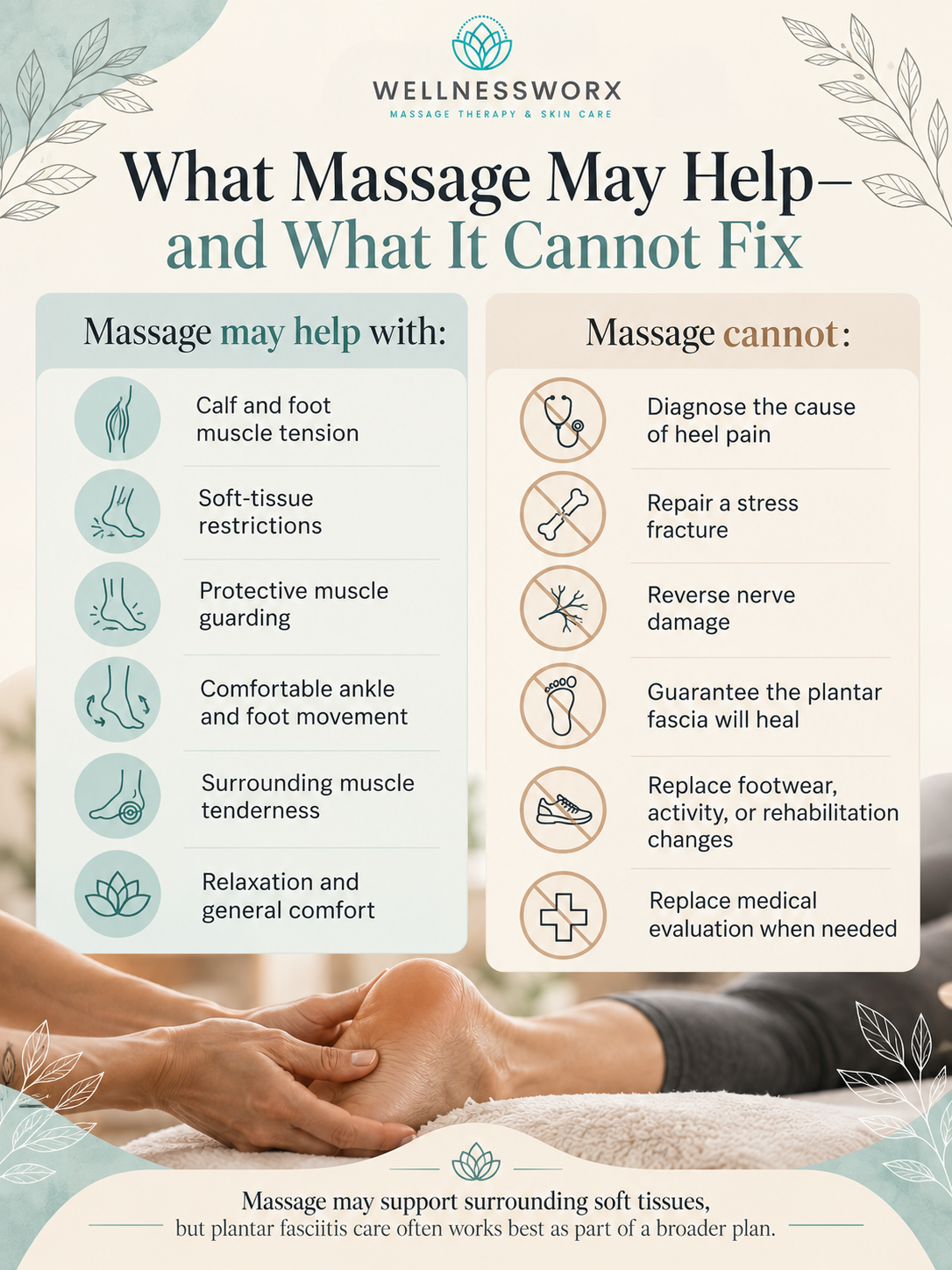
Massage may help with:
Calf and foot muscle tension
Soft-tissue restrictions
Protective muscle guarding
Comfortable ankle and foot movement
Tender or overworked surrounding muscles
General relaxation and comfort
Massage cannot:
Diagnose the cause of heel pain
Repair a stress fracture
Reverse nerve damage
Guarantee that the plantar fascia will heal
Replace appropriate footwear or activity changes
Replace medically necessary physical therapy or rehabilitation
Guarantee pain-free walking
Correct every biomechanical contributor to plantar fasciitis
Massage may support surrounding tissues, but successful plantar-fascia care often requires addressing why the area is being repeatedly overloaded.
Six Ways Massage May Support Plantar Fasciitis and Foot Pain
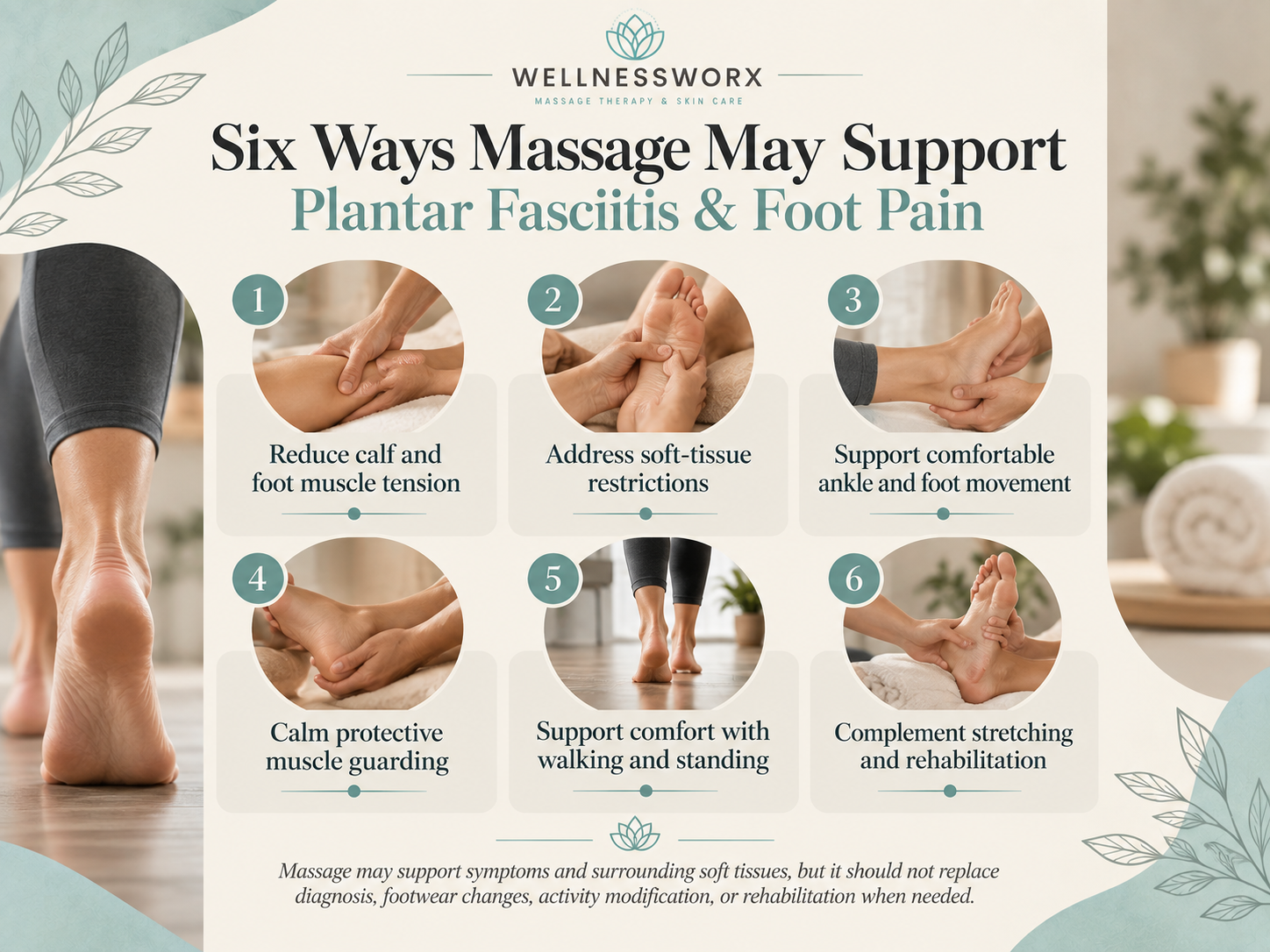
1. It May Reduce Calf and Foot Muscle Tension
The foot does not function in isolation.
The calf muscles connect into the Achilles tendon and influence how the ankle moves when you walk. Tightness through this region may contribute to reduced ankle dorsiflexion—the ability to bring the top of the foot toward the shin.
Reduced ankle dorsiflexion has been associated with plantar heel pain, which is one reason calf flexibility is commonly addressed during treatment.
Massage may help reduce muscular tension through areas such as the:
Gastrocnemius
Soleus
Muscles around the ankle
Intrinsic muscles of the foot
This may make stretching and comfortable movement easier for some clients.
2. It May Address Soft-Tissue Restrictions
Some people with plantar heel pain also have tenderness or restricted-feeling tissues through the calf, ankle, arch, or foot.
A therapist may use gentle soft-tissue techniques to work with those areas.
Treatment should not simply involve aggressively pressing into the most painful point on the heel.
The intensity should be customized according to tenderness, symptom severity, health history, and how the foot responds.
3. It May Support Comfortable Ankle and Foot Movement
Plantar fasciitis can cause people to move differently because walking hurts.
They may:
Take shorter steps
Avoid putting weight through the painful heel
Shift weight to the opposite foot
Change how the ankle moves
Walk more on the outside or front of the foot
These adaptations may create tension elsewhere.
Massage may help surrounding muscles feel more comfortable while the underlying foot problem is being managed.
4. It May Calm Protective Muscle Guarding
Pain often causes the body to brace automatically.
The calf, ankle, and foot muscles may remain more tense because the person is anticipating heel pain with each step.
Massage may reduce some of this muscular guarding.
That does not mean the therapist should force a painful foot to relax through heavy pressure. Treatment should remain tolerable and should be adjusted if symptoms increase.
5. It May Support Comfort With Walking and Standing
If muscular tightness is contributing to discomfort, massage may provide a temporary period in which standing or walking feels easier.
That window can sometimes be useful for completing healthcare-provider-recommended:
Mobility work
Strengthening
Walking
Physical therapy exercises
The objective is not simply temporary symptom relief, but helping support the broader recovery plan.
6. It May Complement Stretching and Rehabilitation
This may be the most important benefit.
The 2023 plantar-fasciitis clinical practice guideline strongly recommends both plantar fascia-specific stretching and calf stretching for short- and long-term improvements in pain and function. It also recommends resistance exercise for the foot and ankle musculature.
Massage may help prepare tense tissues for movement or make stretching feel more comfortable, but it should not replace those active strategies when they are recommended.
Should the Therapist Massage Directly on the Plantar Fascia?
Possibly, but treatment should be individualized. Some clients tolerate gentle work along the arch or plantar tissues well. Others—particularly during a painful flare—may find direct pressure irritating.
Your therapist may instead spend more time working with:
Calves
Ankle muscles
Surrounding foot muscles
Areas of compensation
The opposite leg if it has been taking more load
There is no benefit to forcing painful pressure into an irritated heel simply because that is where the client feels the symptoms.
Does Plantar Fasciitis Massage Need to Hurt?
No. Massage for plantar heel pain should not require you to endure intense pain.
Some tight tissues may feel tender, but you should speak up if treatment causes:
Sharp heel pain
Burning
Electric sensations
Increasing numbness
Tingling
Significant swelling
Pain that gets progressively worse
An unfamiliar neurological sensation
NCCIH notes that massage is generally low risk when provided appropriately, but vigorous techniques may be unsuitable for certain people or conditions.
What Areas Might the Massage Therapist Treat?
Your therapist may work beyond the bottom of the foot.
Depending on your symptoms, treatment might include the:
Foot
Arch
Calf
Soleus
Gastrocnemius
Muscles surrounding the ankle
Lower leg
Other areas compensating for an altered walking pattern
Treatment should be based on the person's symptoms rather than assuming every plantar-fasciitis client needs the same routine.
What Techniques Might Be Used?
Treatment may include:
Therapeutic massage
Soft-tissue mobilization
Myofascial techniques
Trigger-point work
Gentle foot massage
Calf massage
Assisted stretching
Mobility-focused bodywork
Cupping in appropriate surrounding areas
No single massage technique has been established as the universal best option for plantar fasciitis.
What Happens During a Massage Appointment for Foot or Heel Pain?
Your therapist should begin with a conversation.
You may be asked:
Where exactly does the pain occur?
Is it on the bottom, side, or back of the heel?
Is morning pain worse?
Does pain occur after sitting?
How long have you had symptoms?
Have you changed exercise or walking habits recently?
Do you stand for long periods at work?
What footwear do you normally wear?
Do you have numbness or tingling?
Do you have diabetes or circulation concerns?
Have you been diagnosed with plantar fasciitis?
Have you had imaging?
Are you currently receiving physical therapy?
What makes the pain better or worse?
These questions help identify whether massage appears appropriate or whether medical evaluation should come first.
What If I Haven't Been Diagnosed With Plantar Fasciitis?
Massage therapists do not diagnose plantar fasciitis.
If your pain has not been medically evaluated, describe it as heel pain or foot pain rather than assuming plantar fasciitis is definitely the cause.
Healthcare professionals may diagnose plantar fasciitis primarily through history and physical examination, while imaging may be used when another cause—such as a stress fracture—is suspected.
What Else Helps Plantar Fasciitis?
Massage should not be the only tool considered. Evidence-based conservative care may include:
Plantar Fascia Stretching
The plantar fascia can be stretched by gently bringing the toes upward while targeting the tissue along the bottom of the foot. Clinical guidelines recommend plantar fascia-specific stretching for reducing pain and improving function.
Calf Stretching
Stretching the gastrocnemius and soleus can help address calf tightness and ankle-mobility restrictions. AAOS also identifies stretching the foot arch and heel cord as important conservative measures for plantar fasciitis.
Appropriate Footwear
Supportive footwear and cushioning may reduce stress on the heel. AAOS recommends shoes with appropriate cushioning and notes that heel cups or similar supports may be helpful for some people.
Activity Modification
A sudden increase in running, walking, standing, or high-impact exercise may aggravate symptoms. Temporarily modifying the activity may allow irritated tissues time to recover.
Strengthening
Current clinical guidelines also recommend resistance training for the musculature of the foot and ankle as part of plantar-fasciitis rehabilitation.
Night Splints
For people with persistent first-step morning pain, clinical guidelines recommend a one- to three-month night-splint program. Your healthcare provider or physical therapist can determine which options are appropriate for you.
What About Foot Pain That Isn't Plantar Fasciitis?
Foot pain has many possible causes.
It may involve:
Achilles tendinitis
Stress fractures
Arthritis
Heel bruising
Bunions
Peripheral neuropathy
Tarsal tunnel syndrome
Metatarsalgia
Tendon problems
Gout
Nerve irritation
Skin or nail problems
Mayo Clinic emphasizes that foot pain can arise from injuries, chronic orthopedic conditions, or medical conditions affecting bones, joints, nerves, or tissues.
Massage may be appropriate for some causes and inappropriate for others.
When Should You Get Medical Care for Heel or Foot Pain?
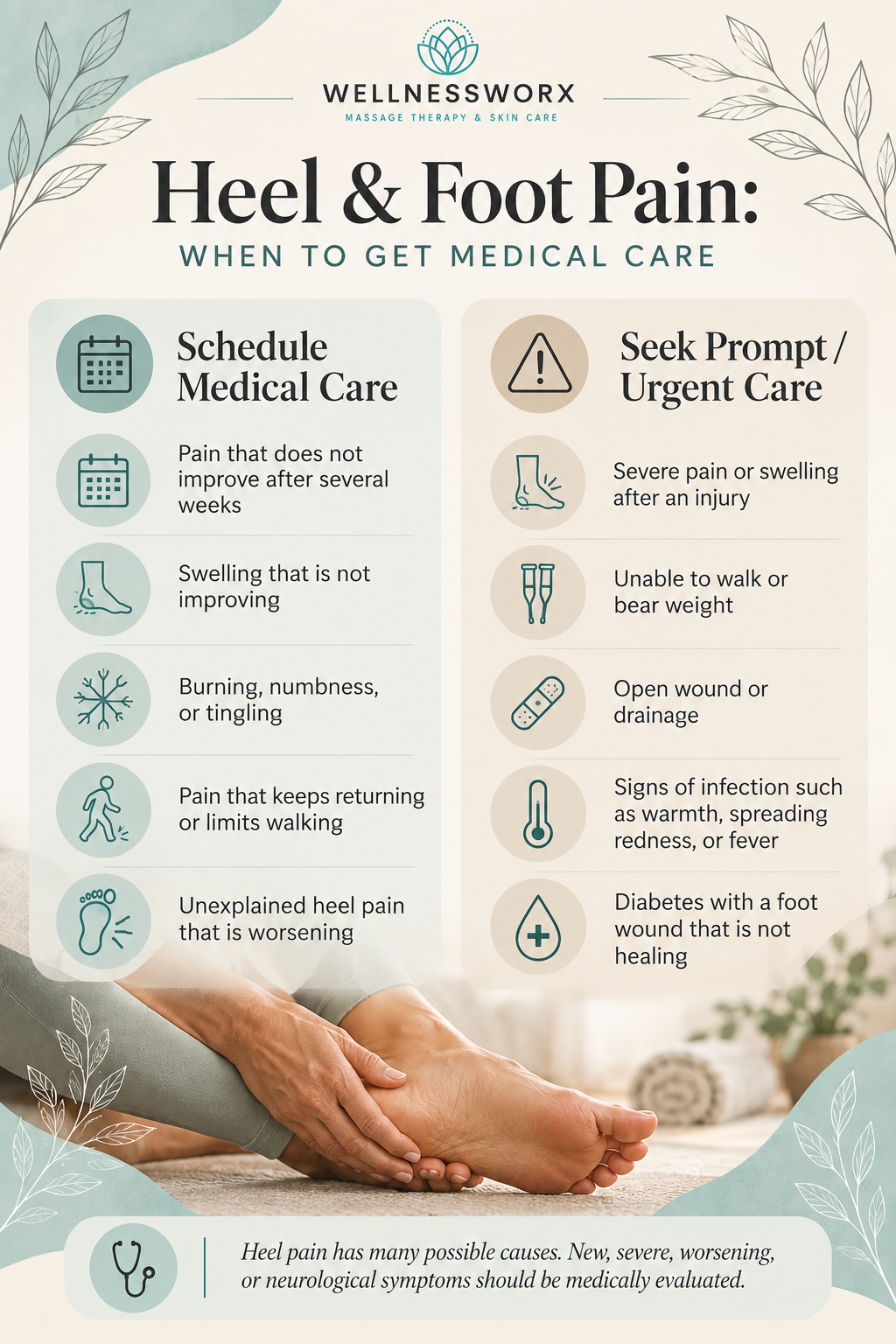
Schedule medical evaluation when:
Pain does not improve after several weeks
Swelling is not improving
Pain repeatedly returns
Walking becomes increasingly limited
You experience burning
You experience numbness or tingling
Heel pain is unexplained and worsening
Mayo Clinic recommends medical evaluation for foot pain that persists for several weeks and for burning, numbness, or tingling affecting the foot.
When Is Foot Pain More Urgent?
Seek prompt medical care if you:
Have severe pain or swelling after an injury
Cannot walk or bear weight
Have an open wound or drainage
Have signs of infection such as increasing warmth, spreading redness, or fever
Have diabetes and a foot wound that is not healing
These symptoms should not be treated primarily with massage.
How Many Massage Sessions Might You Need?
There is no standard number. Some people may notice a temporary decrease in muscle tension after one session. Others may receive massage periodically while following a rehabilitation program.
Frequency should depend on:
Symptom severity
Diagnosis
Response to treatment
Activity demands
Footwear changes
Exercise or physical therapy
Treatment goals
Other medical recommendations
Massage should not continue indefinitely without reassessing whether it is producing a meaningful benefit.
Can Cupping or Stretch Therapy Be Used Too?
Potentially. For clients with significant calf tightness or reduced mobility, WellnessWorx may incorporate or recommend complementary approaches such as therapeutic massage, stretch therapy, cupping, or other bodywork based on the person's needs and comfort.
WellnessWorx currently offers medical massage, therapeutic massage, sports massage, cupping, and guided stretch therapy in Glendora.
These services should complement—not replace—appropriate medical or rehabilitative treatment.
Massage for Plantar Fasciitis and Foot Pain in Glendora, CA
WellnessWorx Massage Therapy & Skin Care provides personalized massage and therapeutic bodywork for people dealing with muscle tension, pain, limited mobility, recovery needs, and everyday physical discomfort.
Instead of following the same routine for every client, treatment can be customized around your symptoms, health history, pressure tolerance, activity level, and movement goals.
For someone experiencing plantar fasciitis or other heel pain, that may mean focusing not only on the foot but also on calf tension, ankle mobility, and surrounding muscles that have become overworked.
WellnessWorx is located at 1200 E Route 66, Suite 115, Glendora, CA 91740 and can be reached at (909) 631-6012.
This article is provided for general educational purposes and is not intended to diagnose plantar fasciitis, prescribe treatment, or replace care from a qualified healthcare professional.
Related Articles
Stretch Therapy vs. Massage Therapy: Which Is Right for You?
Can Massage Help Lower-Back Pain? Benefits, Limitations, and What to Expect
What to Expect During Your First Medical Massage Appointment
Frequently Asked Questions
-
No. Massage cannot be guaranteed to cure plantar fasciitis. It may help address calf and foot muscle tension, soft-tissue restrictions, guarding, and movement comfort while complementing stretching, strengthening, footwear changes, physical therapy, or other recommended care.
-
Not always. Some people tolerate gentle work around the arch and plantar tissues, while others find direct pressure painful. A therapist may instead focus on the calf, ankle, foot muscles, and surrounding tissues. Pressure should be adjusted according to symptoms and comfort.
-
It may be useful when calf tightness or reduced ankle mobility contributes to the problem. Plantar-fasciitis clinical guidelines emphasize calf and plantar-fascia stretching, and manual therapy may be used to address relevant soft-tissue and mobility restrictions.
-
Plantar fasciitis commonly causes pain near the bottom of the heel that is especially noticeable with the first steps in the morning or after sitting. However, heel pain has several possible causes. Persistent, severe, unusual, or neurological symptoms should be evaluated by a healthcare professional.
-
Massage should be postponed or medically cleared when foot pain is associated with severe injury, inability to bear weight, significant swelling, an open or infected wound, unexplained neurological symptoms, or another condition in which massage may be unsafe.
