
What to Expect During Your First Medical Massage Appointment
Scheduling your first medical massage appointment can feel different from booking a traditional relaxation massage. You may be wondering what to wear, how much of your health history you need to share, whether the treatment will hurt, or what happens if you are uncomfortable during the session.
Medical massage is typically focused on a specific concern, such as chronic pain, recurring muscle tension, injury-related discomfort, restricted movement, headaches, sciatica-related symptoms, or difficulty completing everyday activities. Instead of following the same full-body routine for every client, the therapist customizes the appointment around your symptoms, health history, comfort, and goals.
Your first appointment will generally include a health intake, a conversation about your concerns, an explanation of the proposed treatment, the hands-on massage, and time to discuss how your body responded.
What Is Medical Massage?
Medical massage is a focused, goal-oriented approach to massage therapy. The purpose is usually to address one or more specific areas of discomfort or limitation rather than concentrating primarily on general relaxation.
Depending on your needs, medical massage may focus on:
Chronic muscle tension
Neck, shoulder, or back discomfort
Limited mobility
Previous injuries
Postural strain
Sciatica-related tension
Headache-related muscle tightness
Sports or activity-related soreness
Muscles compensating for another painful area
At WellnessWorx, medical massage appointments are personalized for clients dealing with concerns such as chronic pain, muscle tension, injury recovery, limited mobility, and everyday discomfort.
Medical massage may still feel relaxing. The main difference is that the techniques, pressure, positioning, and treatment areas are selected to support a particular goal.
Before Your Appointment
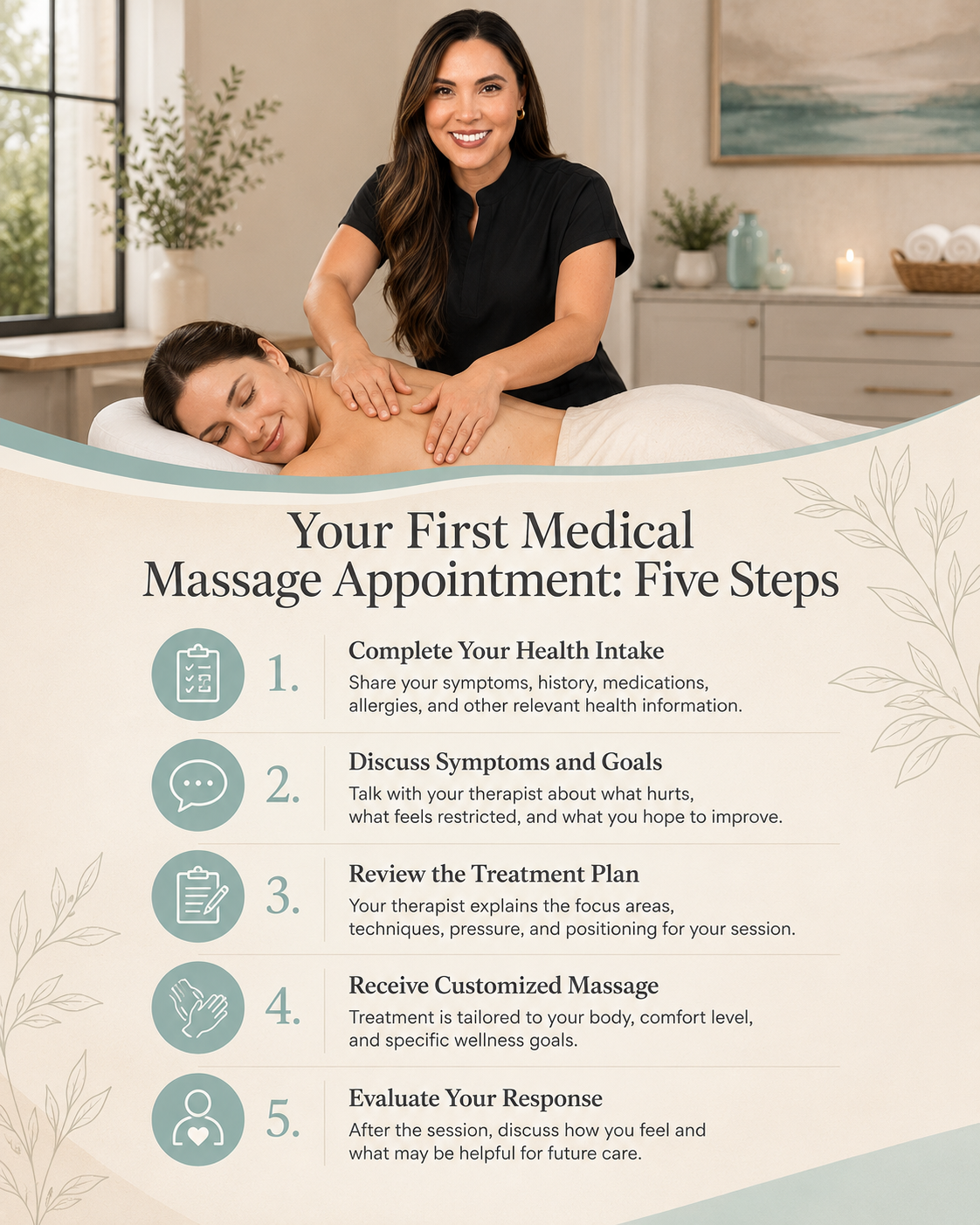
A little preparation can help your therapist understand your needs and make the session more comfortable.
Complete your health-intake information honestly
Your therapist may ask you to complete a client intake form before treatment. Professional massage organizations recommend using an intake process to understand a new client’s medical conditions, expectations, and other factors that could affect treatment.
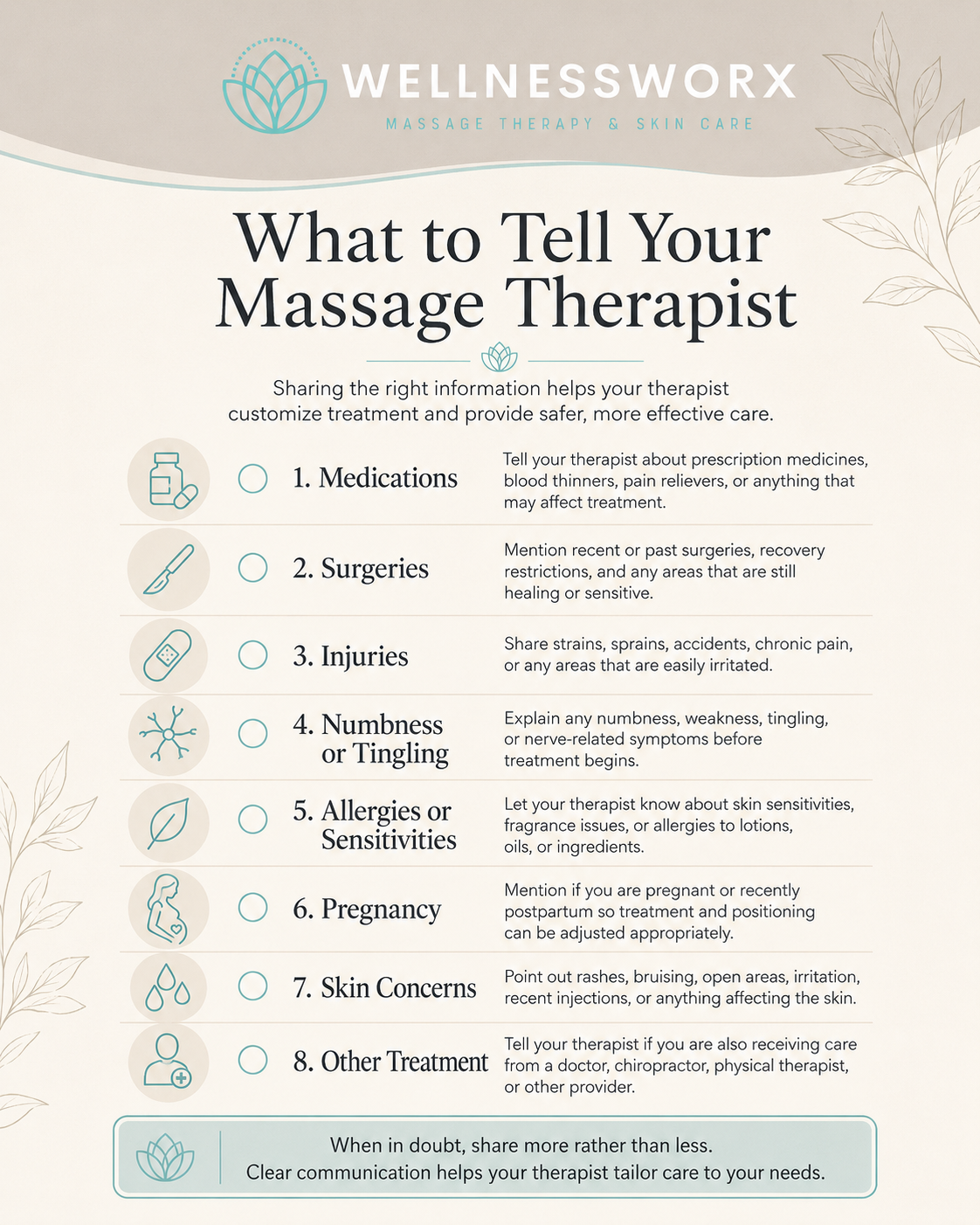
Be prepared to share information about:
Current areas of pain, tension, or sensitivity
Previous injuries
Surgeries
Diagnosed health conditions
Medications
Allergies
Pregnancy
Recent medical procedures or injections
Numbness, tingling, or weakness
Blood-clot history
Skin irritation, wounds, or infections
Other care you are receiving
Do not leave out information because it seems unrelated. A medication, operation, circulation issue, or previous injury may affect how you should be positioned or which areas and techniques should be avoided.
Bring helpful medical information when appropriate
Most clients will not need to bring an extensive medical file. However, it may help to bring or summarize:
Your healthcare provider’s diagnosis
Treatment restrictions
Relevant imaging results
Physical-therapy recommendations
Surgical instructions
A list of medications
Details about when your symptoms began
WellnessWorx does not generally require a physician’s referral for medical massage, although a referral or authorization may be involved when care is connected to insurance, VA Community Care, or another healthcare provider.
Wear comfortable clothing
Wear clothing that is easy to change out of and put back on. Depending on the treatment plan, the therapist may be able to perform some techniques through clothing or may recommend that the treatment area be directly accessible.
Avoid clothing that is difficult to remove, restrictive, or covered in complicated fasteners. You may also wish to remove jewelry that could interfere with treatment around the neck, shoulders, arms, or hands.
The Initial Conversation
Your first medical massage appointment should begin with a conversation rather than immediately starting hands-on treatment.
Your therapist may ask:
Where do you feel discomfort?
When did it begin?
Is the pain constant or intermittent?
What does it feel like?
What makes it better or worse?
Does it travel into another area?
Do you experience numbness, tingling, or weakness?
Which activities are difficult?
What other treatments have you tried?
How did you respond to previous massage?
What would you like to improve?
WellnessWorx describes the first appointment as beginning with a discussion of your health history, symptoms, pain areas, and goals so the therapist can develop an individualized treatment plan.
Setting Useful Treatment Goals
A useful medical massage goal is often more specific than simply saying, “I want less pain.”
Your goal might be to:
Turn your head more comfortably
Sit at your desk with less shoulder tension
Reach overhead more easily
Walk with less guarding
Sleep in a more comfortable position
Return to exercise
Reduce tension around the base of the skull
Complete physical-therapy exercises more comfortably
Improve comfort while driving
Experience fewer activity-related flare-ups
Specific goals give your therapist a clearer way to plan treatment and evaluate whether the approach is helping.
Medical massage cannot guarantee that pain will completely disappear. Progress may instead appear as improved movement, greater activity tolerance, reduced muscle guarding, or better daily comfort.
Your Therapist May Perform a Brief Assessment
Before beginning treatment, the therapist may observe or ask about how you move.
Depending on the concern, this might include:
Turning your head
Raising your arms
Bending or rotating
Describing where movement feels restricted
Identifying tender areas
Comparing comfort on the left and right sides
Discussing your posture during work or daily activities
This is not the same as a physician’s diagnostic examination. Massage therapists do not diagnose fractures, disc injuries, nerve damage, arthritis, or other medical conditions.
The assessment is used to understand your current comfort and determine which soft tissues may be appropriate to address.
Discussing the Treatment Plan
Before the massage begins, your therapist should explain:
Which areas they recommend treating
Which techniques may be used
What position you will be in
What level of pressure may be appropriate
Whether stretching or movement may be included
Which areas should be avoided
How you can communicate during the session
Professional massage guidelines state that clients should receive an explanation of the massage and techniques before treatment and should be able to consent to—or decline—the proposed techniques and pressure.
Ask questions whenever something is unclear. You do not have to agree to a technique or treatment area that makes you uncomfortable.
What Should You Wear During the Massage?
The amount of clothing you remove is based on your comfort and the areas being treated.
You may choose to:
Remain fully clothed
Remove only clothing covering the treatment area
Leave undergarments on
Undress to your comfort level
You should be given privacy to change.
During table massage, you should be covered with a sheet, towel, or blanket, with only the area currently being treated exposed. Appropriate draping, privacy, dignity, and professional boundaries are fundamental expectations during a massage appointment.
You can ask your therapist to explain the draping process before treatment begins.
How Will You Be Positioned?
Many massages are performed while the client lies face down or face up, but those are not the only options.
Depending on your symptoms and mobility, you may be positioned:
Face down
Face up
On your side
Partially elevated
Seated
With pillows or bolsters beneath the knees, ankles, shoulders, or hips
A padded massage table, face cradle, cushions, and bolsters may be used to support the body and reduce strain.
Tell your therapist if a position increases pain, causes numbness, makes breathing difficult, or simply feels uncomfortable. Positioning should be changed when needed.
What Happens During the Hands-On Treatment?
The hands-on portion of a medical massage may concentrate on one or two areas rather than the entire body.
Your session could include:
General therapeutic massage
Myofascial techniques
Trigger-point work
Carefully selected deep-tissue techniques
Gentle stretching
Mobility-focused bodywork
Swedish-style movements
Focused work around compensating muscles
Relaxation techniques
Massage therapists use varying pressure and movement when working with muscles, connective tissue, tendons, ligaments, and skin.
The exact techniques should depend on your health history, symptoms, sensitivity, and goals—not on a one-size-fits-all routine.
Does Medical Massage Have to Hurt?
No. Medical massage does not have to cause intense pain to be useful.
Some focused work may feel tender, particularly when muscles have been tight or overworked for a long time. However, pressure should remain tolerable and should not cause you to hold your breath, clench your muscles, or feel that you must endure the treatment.
Tell your therapist immediately if you experience:
Sharp or shooting pain
Burning
Increasing numbness or tingling
Muscle weakness
Dizziness
Nausea
Pain traveling into another area
A sudden headache
A significant increase in sensitivity
Any unfamiliar or alarming sensation
Your therapist should check on pressure and comfort and make adjustments when requested. You also have the right to ask for a technique to stop or to end the session entirely.
Communication During the Session
Your therapist needs feedback to customize the appointment properly.
Helpful statements include:
“That pressure is too strong.”
“Could you use a little more pressure?”
“That is causing tingling.”
“My neck is uncomfortable in this position.”
“That area feels tender but manageable.”
“I would prefer not to have that area treated.”
“Could we stop for a moment?”
You may also decide whether you prefer conversation, music, or quiet. AMTA guidance recognizes the client’s right to request quiet, ask questions, change the pressure, and stop the treatment.
Speaking up is not being difficult. It gives the therapist the information needed to provide safer and more appropriate care.
Products Used During Treatment
A therapist may use massage oil, cream, or lotion to reduce friction.
Before treatment, tell the therapist about:
Skin allergies
Fragrance sensitivity
Nut allergies
Sensitive or reactive skin
Recent cosmetic treatments
Rashes or irritation
Adhesive allergies
Products you prefer to avoid
Professional guidance recommends informing the therapist in advance about allergies to oils or lotions.
What Happens After the Massage?
After the session, your therapist should give you privacy and enough time to get up slowly and get dressed.
The therapist may then ask:
How does the treated area feel?
Does movement feel different?
Did any technique aggravate your symptoms?
Do you feel dizzy or lightheaded?
Did the pressure feel appropriate?
Is your original functional goal any easier?
WellnessWorx may also provide individualized suggestions involving stretching, hydration, or follow-up care when appropriate.
Recommendations should be relevant to your needs. You do not need to drink an extreme amount of water or follow claims about “flushing toxins” from your body.
Is Soreness Normal After Medical Massage?
Mild, temporary tenderness may occur after focused massage, particularly when unfamiliar techniques or deeper pressure were used.
Significant pain, new neurological symptoms, or prolonged worsening should not simply be dismissed as normal soreness.
Contact an appropriate healthcare professional if you experience concerning symptoms such as:
New weakness
Increasing numbness or tingling
Severe or rapidly worsening pain
Significant swelling
Chest pain
Shortness of breath
Fever
Loss of balance
A suspected blood clot
Symptoms that feel substantially different from your usual discomfort
Massage is generally considered low risk when appropriately performed, but rare serious complications—including nerve injury, bone fracture, or a blood clot—have been reported, especially with vigorous techniques or people at increased risk of injury.
When Should You Speak With a Healthcare Provider Before Massage?
Ask for medical guidance before treatment when you have:
New or unexplained pain
A recent injury
Recent surgery
An active infection
Fever
Open wounds or burns
A known or suspected blood clot
Significant unexplained swelling
Unhealed fractures
Active cancer treatment
A bleeding disorder
Blood-thinning medication
Severe osteoporosis
New numbness or weakness
A medical restriction against massage
NCCIH advises people not to use massage to delay evaluation of a medical problem and recommends asking a healthcare provider when there is uncertainty about whether massage is appropriate.
Will You Need More Than One Appointment?
That depends on your symptoms, goals, response, health history, and other care you are receiving.
Some clients schedule one appointment to address a temporary area of tension. Others use several appointments as part of a recovery, mobility, or chronic-pain plan.
Your therapist may discuss:
What changed after the session
Whether the same techniques should be repeated
Whether pressure should be adjusted
Whether different areas should be treated
How frequently appointments may be useful
When further medical evaluation is appropriate
A treatment plan should be reassessed rather than automatically continued indefinitely.
Your First Medical Massage at WellnessWorx in Glendora
WellnessWorx Massage Therapy & Skin Care provides personalized medical massage for people experiencing chronic pain, muscle tension, injury-related discomfort, limited mobility, and other concerns affecting everyday comfort.
Your first appointment begins with a conversation about your symptoms, history, pain areas, and goals. The therapist then develops a customized plan, explains the recommended techniques, and adjusts pressure and positioning according to your feedback.
To request an appointment, call (909) 631-6012 or request an appointment online.
This article is provided for general educational purposes. It is not intended to diagnose a condition, provide medical advice, or replace evaluation from a qualified healthcare professional.
Frequently Asked Questions
-
Wear comfortable clothing that is easy to change out of and put back on. During the session, you may remain clothed or undress to your comfort level, depending on the areas being treated. You should be appropriately draped, with only the treatment area exposed.
-
No. You control how much clothing you remove. Medical massage can sometimes be performed through clothing, and you may keep undergarments or other clothing on. Tell your therapist what feels comfortable before the session begins.
-
Medical massage may involve focused pressure, and some tight areas may feel tender. However, treatment should not require severe pain. Tell your therapist immediately about sharp pain, burning, numbness, tingling, dizziness, or pressure that feels too intense.
-
The appointment length depends on the service booked and whether intake or assessment time is included. Table-massage sessions commonly range from approximately 30 to 90 minutes, but you should confirm the exact duration when scheduling.
-
A referral is not generally required for most WellnessWorx medical massage appointments. However, a referral, authorization, or medical clearance may be needed when treatment involves insurance, VA Community Care, a recent operation, a complex condition, or another healthcare provider’s care plan.
