
Neck and Shoulder Pain From Sitting at a Desk: Can Massage Help?

By the end of a long workday, does your neck feel stiff, your shoulders feel like they are creeping toward your ears, or the area between your shoulder blades feel tight and tired?
Desk work may not look physically demanding, but spending hours looking at a screen, using a mouse, typing, or remaining in the same position can place ongoing demands on the muscles of the neck, shoulders, and upper back.
Neck pain often becomes worse when the head is held in the same position for long periods, such as while driving or working at a computer. Muscle tightness, spasms, reduced neck movement, and headaches may accompany it.
Massage therapy may help some people manage the muscular side of desk-related neck and shoulder discomfort. It may reduce tension, address overworked muscles, calm protective guarding, and make movement feel more comfortable.
However, massage does not correct every cause of neck or shoulder pain—and the best long-term strategy usually includes looking at how you work, how long you remain in one position, and how often you move throughout the day.
Why Can Sitting at a Desk Make Your Neck and Shoulders Hurt?
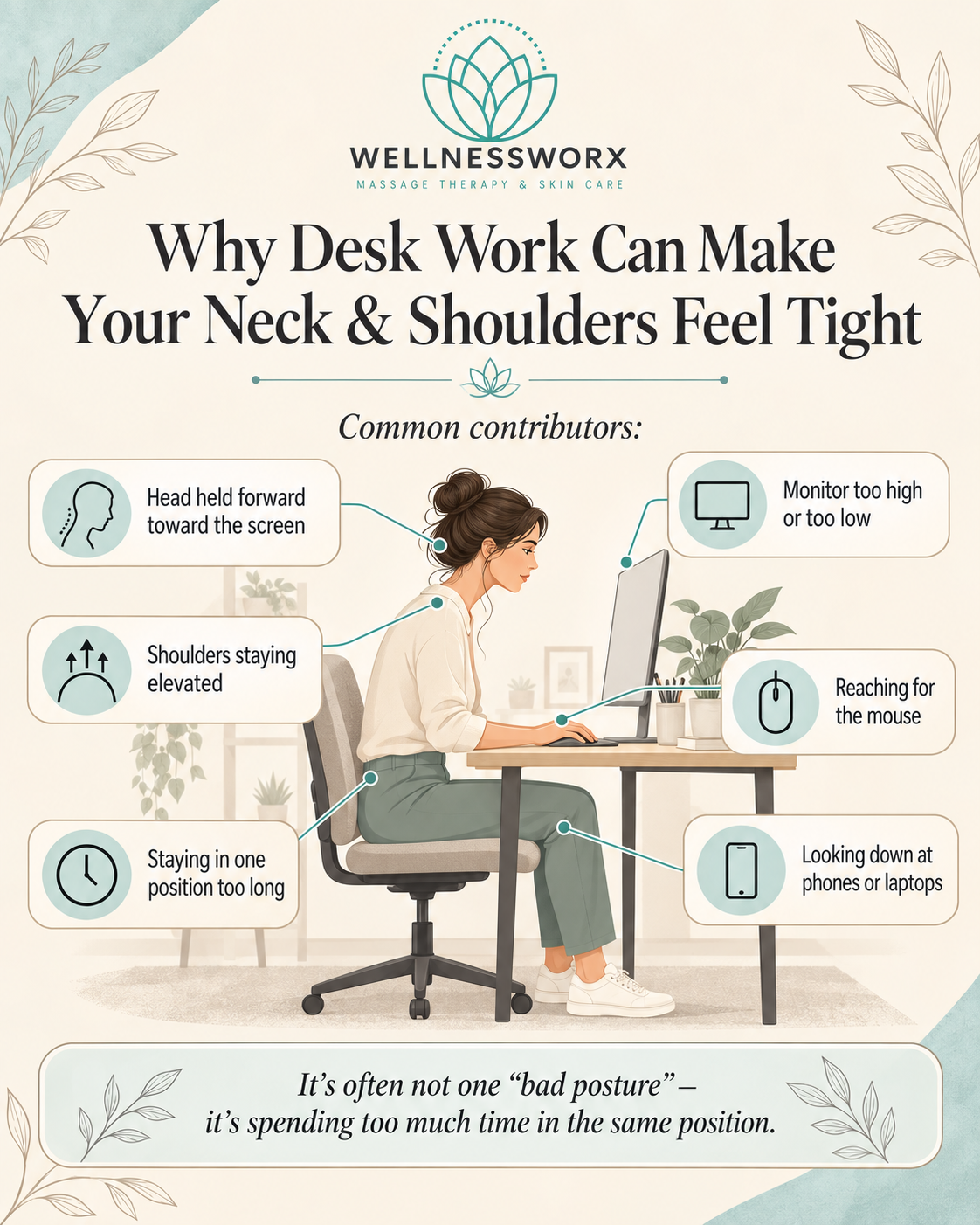
There usually is not one single culprit.
Desk-related discomfort often develops from a combination of sustained positioning, repetitive movement, workstation setup, stress, and not moving enough throughout the day.
Common contributors may include:
Holding your head forward while looking at a screen
Looking down at a laptop
Reaching for a mouse
Keeping one arm elevated
Working with the shoulders slightly shrugged
Turning toward a second monitor
Looking down at a phone
Sitting without adequate back support
Remaining in one position for long periods
Repetitive keyboard or mouse use
Stress-related muscle tension
Bending over a desk for long periods and having a monitor positioned too high or too low among common everyday contributors to neck muscle strain and tension.
Prolonged static postures can fatigue the neck and shoulder muscles that support the head. A mouse positioned too far away may also force the shoulder and arm to work continuously in an elevated or extended position. Is “Bad Posture” Really the Problem?
Not quite as simply as it is sometimes presented.
There is no need to sit perfectly upright and rigid for eight hours. In fact, even a well-aligned posture becomes uncomfortable when you remain in it too long.
Changing working positions throughout the day, adjusting your chair or backrest, stretching, standing, walking periodically, and alternating some tasks between sitting and standing.
So instead of thinking:
“I need perfect posture.”
a more useful goal is:
“I need a comfortable workstation and enough movement variety that the same muscles aren't working all day.”
What Does Desk-Related Neck and Shoulder Tension Feel Like?
People commonly describe:
Tightness across the tops of the shoulders
A stiff neck
Tender spots or “knots”
Aching between the shoulder blades
Difficulty turning the head comfortably
Muscle fatigue toward the end of the workday
Tension at the base of the skull
Headaches associated with neck and shoulder tension
A feeling that the shoulders need to be stretched constantly
Discomfort that improves after movement or changing positions
Some of these symptoms can be muscular.
However, neck pain can also involve joints, discs, nerves, arthritis, injuries, and other conditions. Pain accompanied by numbness, tingling, weakness, or symptoms traveling into the arm deserves additional attention.
Can Massage Help Neck and Shoulder Pain From Desk Work?
Massage may help—particularly when muscle tension, tenderness, fatigue, or guarding are part of the problem.
Research reviewed by the National Center for Complementary and Integrative Health suggests massage may provide short-term benefits for neck or shoulder pain. However, the research is limited, and massage has not consistently performed better than other active treatments.
That makes massage most appropriate to think of as one piece of the solution.
It may help you feel and move better, while workstation changes, regular movement, exercise, stretching, physical therapy, or medical care address other contributors.
Six Ways Massage May Support Desk-Related Neck and Shoulder Pain
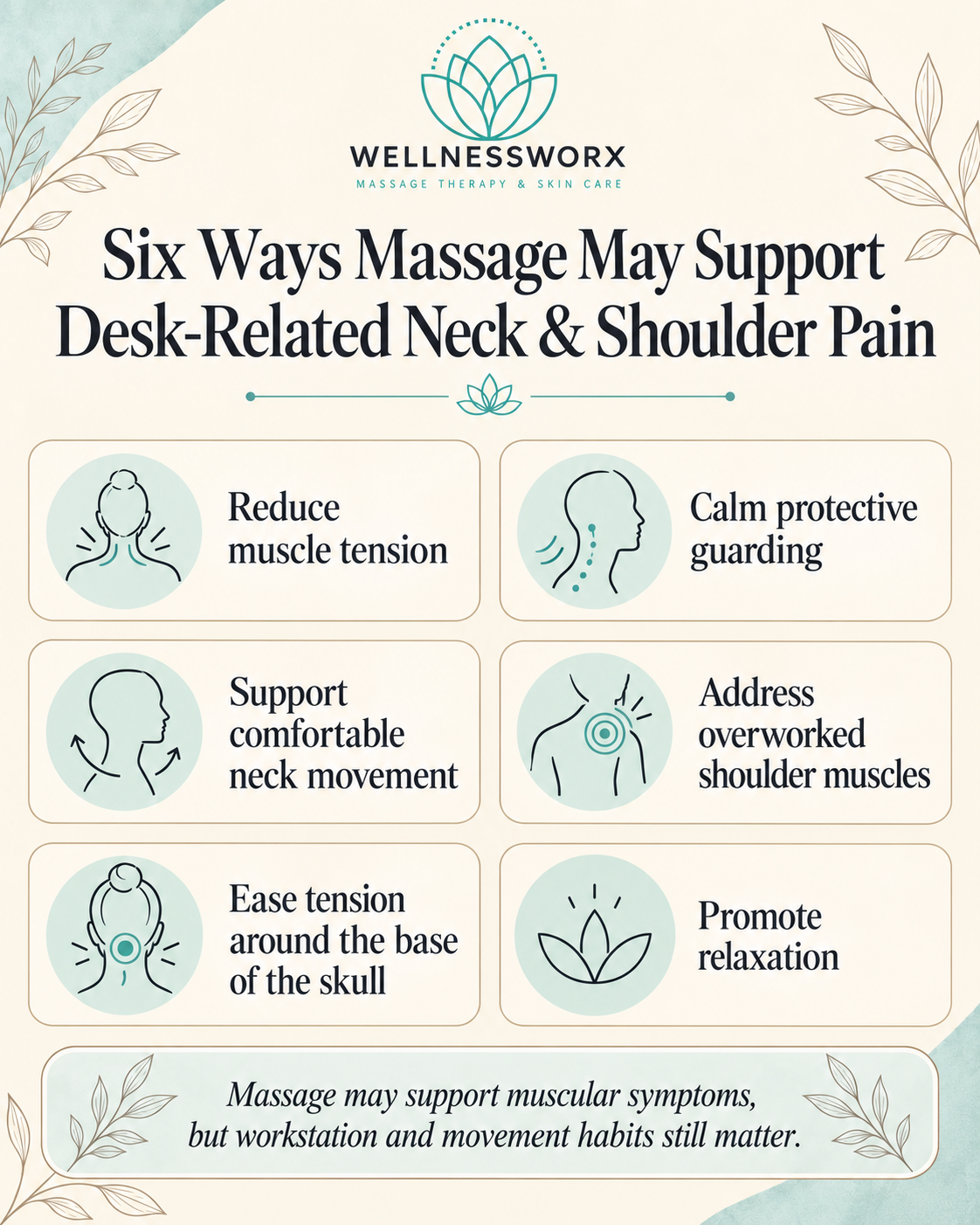
1. It May Reduce Muscle Tension
The muscles around the neck, shoulders, and upper back work throughout the day to support your head and arms.
When your work requires you to remain still for long periods, some of these muscles may stay active without much opportunity to recover.
Massage may help reduce the sensation of tightness and tenderness in overworked muscles.
Common treatment areas may include:
Upper trapezius
Muscles around the shoulder blades
Upper back
Neck
Base of the skull
Shoulders
Chest
Your therapist should select treatment areas based on your symptoms rather than following the same routine for every desk worker.
2. It May Address Protective Muscle Guarding
When an area becomes uncomfortable, the body may tighten surrounding muscles in response.
You may find yourself:
Shrugging your shoulders
Holding your neck stiffly
Avoiding turning your head
Bracing the upper back
Keeping one shoulder higher than the other
Massage may help some of those guarded muscles relax.
The goal is not to force them into submission with heavy pressure. Gentle or moderate techniques may sometimes be more appropriate, especially when an area is already irritated.
3. It May Help Neck Movement Feel More Comfortable
Desk-related tension may make turning your head, looking over your shoulder, or tilting your neck feel restricted.
When soft-tissue tension contributes to the limitation, massage may help make these movements feel more comfortable.
Mayo Clinic notes that massage may help some people with chronic neck pain obtain relief from tightened muscles.
Massage cannot restore motion that is being limited by every joint, nerve, or structural condition. Persistent or significant loss of motion should be appropriately evaluated.
4. It May Address Muscles Affected by Mouse and Keyboard Use
Your pain may not come only from the back of your neck.
A mouse that is positioned too far away can cause you to hold your arm away from the body, increasing the workload on neck and shoulder muscles. Keeping frequently used equipment within easy reach and the elbows close to the body when possible.
A therapist may therefore address:
Shoulders
Upper arms
Forearms
Chest
Upper back
Muscles around the shoulder blades
depending on your work habits and symptoms.
5. It May Help With Tension at the Base of the Skull
People who spend hours looking at screens sometimes develop tenderness where the neck meets the skull.
This area may also become tense when the head remains slightly forward for long periods.
Gentle massage around the upper neck and base of the skull may help reduce muscular tension in that area.
If you also experience recurring headaches, it is important not to automatically assume the headache is caused by muscle tension. New, severe, or changing headaches should be medically evaluated.
6. It May Promote Relaxation
A demanding workday may involve both physical and mental tension.
Some people notice themselves clenching their jaw, lifting their shoulders, or holding their breath when concentrating or feeling stressed.
Massage may provide an opportunity for the body to relax while also addressing the muscular areas that feel overworked.
This does not mean that neck pain is “just stress.” Relaxation is simply one potential benefit of treatment.
Which Muscles Might a Massage Therapist Address?
A desk-worker massage should not necessarily involve pressing directly on the same painful point for an entire session.
Depending on your symptoms, treatment may include the:
Neck
Upper trapezius
Upper back
Muscles between the shoulder blades
Shoulders
Base of the skull
Chest
Upper arms
Forearms
External jaw muscles when appropriate
For example, someone who spends the entire day reaching forward may have tension across the chest and front of the shoulders as well as discomfort across the upper back.
Looking at the entire pattern can be more useful than treating only the location where you feel pain.
What Massage Techniques May Be Used?
There is no single massage technique proven to be best for desk-related neck pain.
Your appointment may incorporate:
Therapeutic massage
Myofascial techniques
Trigger-point work
Carefully selected deep-tissue techniques
Gentle stretching
Mobility-focused work
Cupping when appropriate
Relaxation techniques
WellnessWorx offers personalized medical massage, therapeutic massage, cupping, and stretch therapy for concerns including neck pain, muscle tension, stiffness, limited mobility, and postural strain.
Does Desk-Related Neck Pain Require Deep-Tissue Massage?
No.
One of the biggest misconceptions is that very tight muscles require very deep pressure.
Pressure should depend on:
Your sensitivity
Current symptoms
Health history
Treatment area
How long symptoms have been present
Your response during the session
Some chronically tense muscles may respond well to firmer work. Others may become more guarded when too much pressure is applied.
Massage does not have to be painful to be useful.
Tell your therapist if you experience:
Sharp pain
Burning
Electric sensations
Numbness
Tingling
Weakness
Dizziness
Increased headache pain
Pain traveling into the arm
Those sensations should not simply be “worked through.”
What Massage Can—and Cannot—Do for Desk Pain
Massage may help with:
Neck muscle tension
Shoulder tightness
Upper-back tenderness
Muscle guarding
Soft-tissue stiffness
Muscle fatigue
Comfortable neck movement
Relaxation
Massage cannot:
Fix a herniated disc
Reverse arthritis
Remove a bone spur
Repair nerve damage
Permanently correct your workstation
Eliminate the effects of sitting in one position all day
Diagnose the source of neurological symptoms
Replace medical evaluation or physical therapy when needed
The best results often come from combining symptom relief with changes to the work habits that may be repeatedly aggravating the area.
What Happens During a Massage Appointment for Desk-Related Neck and Shoulder Pain?
Your therapist should first ask about your symptoms and work routine.
Questions may include:
Where do you feel the discomfort?
When during the workday does it become noticeable?
How many hours do you spend at a computer?
Do you use a laptop or desktop?
Do you use more than one monitor?
Which hand uses the mouse?
Do you work from home?
Does pain travel into an arm?
Do you experience numbness or tingling?
Do you get headaches?
Which movements feel restricted?
What makes the discomfort better?
What type of massage pressure do you prefer?
The therapist can then develop a treatment plan based on the muscles and movement patterns involved.
Do You Have to Lie Face Down?
No.
Depending on what feels comfortable, treatment may be performed:
Face down
Face up
Side-lying
Seated
With the upper body partially elevated
Pillows and bolsters can be used to support the neck, shoulders, arms, and knees.
If lying face down makes your neck feel worse, tell your therapist. Positioning should be changed rather than tolerated.
Massage Helps—But What Happens When You Go Back to the Same Desk?
This is one of the most important parts of the article.
Imagine receiving a great massage on Saturday, feeling noticeably looser, and then returning Monday morning to eight uninterrupted hours at the same workstation.
Massage may relieve some of the muscular consequences, but it does not change the environment that contributed to them.
That is why workstation setup and movement habits matter.
Five Workstation Changes That May Help
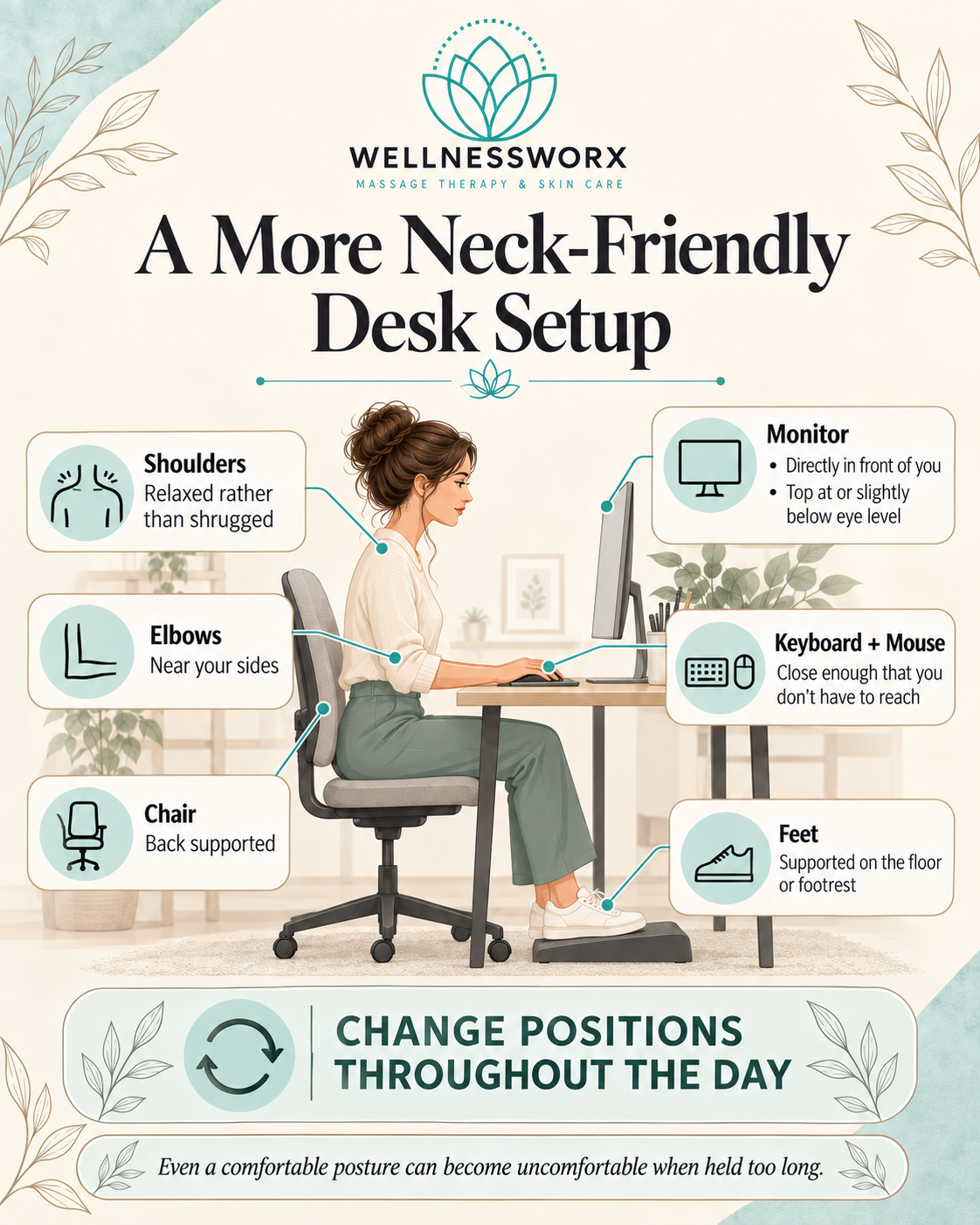
1. Position Your Monitor in Front of You
Avoid spending hours with your head turned toward one side.
OSHA recommends placing the monitor directly in front of you so the head, neck, and torso can face forward.
If you use two monitors but spend most of your time on one, place the primary screen more directly in front of you.
2. Adjust Your Monitor Height
A monitor that is too high or too low may encourage prolonged neck bending.
OSHA recommends placing the top of the monitor at or slightly below eye level, with the screen positioned so you can view it without repeatedly tilting the head forward or backward.
3. Keep Your Mouse Close
If your mouse sits far away, you may spend hours reaching forward or sideways.
OSHA notes that this can require the neck and shoulder muscles to continually support the arm. Keep your mouse and keyboard within easy reach so your elbows can remain reasonably close to your body.
4. Support Your Back and Feet
Your chair should provide back support while allowing your feet to rest on the floor or a footrest.
OSHA recommends a supported back, relaxed shoulders, elbows near the body, and feet fully supported. You do not need to freeze yourself in that position, though.
Which brings us to the most important recommendation.
5. Change Positions
Your next posture may be more important than your “perfect” posture.
OSHA recommends changing your working position frequently, standing or walking periodically, and incorporating short breaks from computer tasks. Its computer-workstation guidance suggests a five-minute break from computer tasks each hour to allow overused muscles and tendons time to recover.
That break does not need to mean stopping work completely.
You might:
Stand during a phone call
Walk to refill your water
Print something at a farther printer
Change from sitting to standing
Roll your shoulders
Gently move your neck
Complete a non-computer task
Walk for a few minutes
Movement variety matters.
What About a Standing Desk?
A standing desk can provide another position, but standing all day is not necessarily the goal.
The benefit is the ability to change positions.
You might alternate among:
Supported sitting
Slightly reclined sitting
Standing
Brief walking
Different work tasks
Adjustable workstations are one way to allow users to change positions and reduce prolonged static loading. Can Stretch Therapy Help Desk Workers Too?
It may be useful when stiffness and restricted movement are part of the problem.
WellnessWorx stretch therapy uses assisted stretching, gentle mobility work, and targeted positioning to support flexibility, reduce tightness, and improve comfortable movement. The service is specifically described as potentially useful for people with desk jobs and postural strain.
For someone whose shoulders feel tender and knotted, massage may be the natural starting point.
For someone who says:
“I don't really hurt—I just feel incredibly stiff and can't move well after sitting all day,”
stretch therapy may also be worth considering.
Some clients may benefit from both approaches.
Can Massage Help “Tech Neck”?
“Tech neck” is an informal term often used to describe discomfort associated with repeatedly looking downward at phones, laptops, or other devices.
The term is not a specific medical diagnosis.
Looking down at smartphones and sitting hunched over computers can strain neck muscles.
Massage may help with the muscular tension associated with these habits, but lasting improvement may also require changing device positioning, taking breaks, and increasing movement variety.
How Often Should You Get Massage for Desk-Related Tension?
There is no universal schedule.
Someone with temporary tension may only need occasional massage.
Another client with a demanding desk schedule may choose a short series of appointments while also making ergonomic and activity changes.
Factors include:
How often symptoms occur
How severe they are
Whether they return immediately
Your response to treatment
Work demands
Exercise habits
Other care you receive
Your goals
Your budget
The objective should not be to create a situation where massage is required forever simply to make it through another workweek.
Ideally, treatment helps while you also identify practical ways to reduce unnecessary strain.
When Should You See a Healthcare Provider?
Not all neck and shoulder pain from someone who works at a desk is actually caused by the desk.
Contact an appropriate healthcare professional if the pain:
Is severe
Continues or worsens despite self-care
Persists for several weeks
Travels down an arm
Is accompanied by numbness
Is accompanied by tingling
Causes muscle weakness
Is associated with a significant headache
Began after an injury
Is accompanied by coordination or balance problems
Mayo Clinic recommends medical evaluation for persistent neck pain and for symptoms that radiate into the arms or legs or occur with headache, weakness, numbness, or tingling. Severe neck pain following trauma requires prompt medical attention.
Massage should complement appropriate care—not delay evaluation of neurological or concerning symptoms.
Massage for Desk-Related Neck and Shoulder Pain in Glendora, CA
WellnessWorx Massage Therapy & Skin Care provides personalized therapeutic and medical massage in Glendora for clients dealing with neck pain, shoulder tension, stiffness, postural strain, limited mobility, chronic muscle tension, and everyday discomfort.
Rather than using the same routine for every client, sessions can be customized around your:
Work habits
Areas of muscle tension
Health history
Pressure preferences
Mobility
Symptoms
Treatment goals
Depending on your needs, treatment may incorporate medical massage, therapeutic massage, deep-tissue techniques, gentle stretching, mobility work, cupping, or other approaches. WellnessWorx also offers dedicated stretch therapy for clients looking to improve mobility and reduce stiffness.
WellnessWorx is located at 1200 E Route 66, Suite 115, Glendora, CA 91740 and can be reached at (909) 631-6012.
This article is provided for general educational purposes and is not intended to diagnose the cause of neck or shoulder pain or replace medical care. New, severe, unexplained, worsening, or neurological symptoms should be evaluated by an appropriate healthcare professional.
Related Articles
Frequently Asked Questions
-
Massage may help when muscle tension, tenderness, guarding, or stiffness contribute to the discomfort. Research suggests massage may provide short-term benefits for some neck and shoulder pain, although results vary and massage does not address every possible cause.
-
Common areas of tension include the neck, upper shoulders, upper back, muscles around the shoulder blades, chest, and base of the skull. The specific pattern depends on workstation setup, how long you remain in one position, mouse placement, device use, and individual movement habits.
-
Not necessarily. Some people respond well to firm pressure, while others need lighter or moderate techniques. More pressure is not automatically more effective. Treatment should be customized to your symptoms and comfort.
-
There is no standard schedule. Frequency depends on your symptoms, response to treatment, work demands, other activity, and goals. Massage may be more useful when combined with workstation adjustments, movement breaks, exercise, or stretch therapy when appropriate.
-
Medical evaluation is recommended when pain is severe, persists or worsens, travels into an arm, follows an injury, or occurs with weakness, numbness, tingling, significant headache, or problems with balance or coordination.
