
Stretch Therapy vs. Massage Therapy: Which Is Right for You?
If your body feels tight, stiff, sore, or difficult to move, you may wonder whether you should schedule a massage—or whether stretch therapy would be a better choice.
Both approaches work with the body to support more comfortable movement, but they do it in different ways.
Massage therapy primarily uses hands-on pressure and soft-tissue techniques to address muscle tension, soreness, guarding, and relaxation.
Stretch therapy uses guided movements, assisted stretching, and positioning to help take joints and muscles through comfortable ranges of motion.
At WellnessWorx Massage Therapy & Skin Care in Glendora, both services can be personalized around your mobility, activity level, comfort, and wellness goals. Stretch therapy is specifically designed to support flexibility, reduce stiffness, and help clients move with less restriction.
Neither approach is automatically better. The right choice depends largely on what you feel, what you want to improve, and how your body responds to treatment.
What Is Stretch Therapy?
Stretch therapy is a guided, hands-on service in which a therapist helps move your body through controlled stretches and mobility-focused movements.
Instead of performing all of the stretching yourself, the therapist assists with positioning and movement so you can relax while the targeted area is gradually taken through a comfortable range.
A session may incorporate:
Assisted stretching
Gentle mobility work
Controlled joint movement
Targeted body positioning
Repeated stretches for specific muscle groups
Movement based on your current flexibility and comfort
WellnessWorx describes stretch therapy as a personalized service intended to help improve flexibility, reduce muscle tightness and stiffness, and support better range of motion.
The objective is not to force the body farther than it wants to go. Stretching should feel controlled and tolerable.
What Is Massage Therapy?
Massage therapy uses hands-on techniques to work primarily with muscles and other soft tissues.
A massage appointment may incorporate:
Swedish-style massage
Medical massage
Sports massage
Trigger-point work
Myofascial techniques
Gentle stretching
Mobility-focused bodywork
Relaxation techniques
Depending on the session, massage may focus on a specific area of discomfort or provide a broader treatment.
At WellnessWorx, massage therapy is personalized for concerns that may include muscle tension, chronic pain, injury recovery, restricted mobility, and general wellness.
Stretch Therapy vs. Massage Therapy: What's the Difference?
The biggest difference is what the therapist is primarily doing with your body.
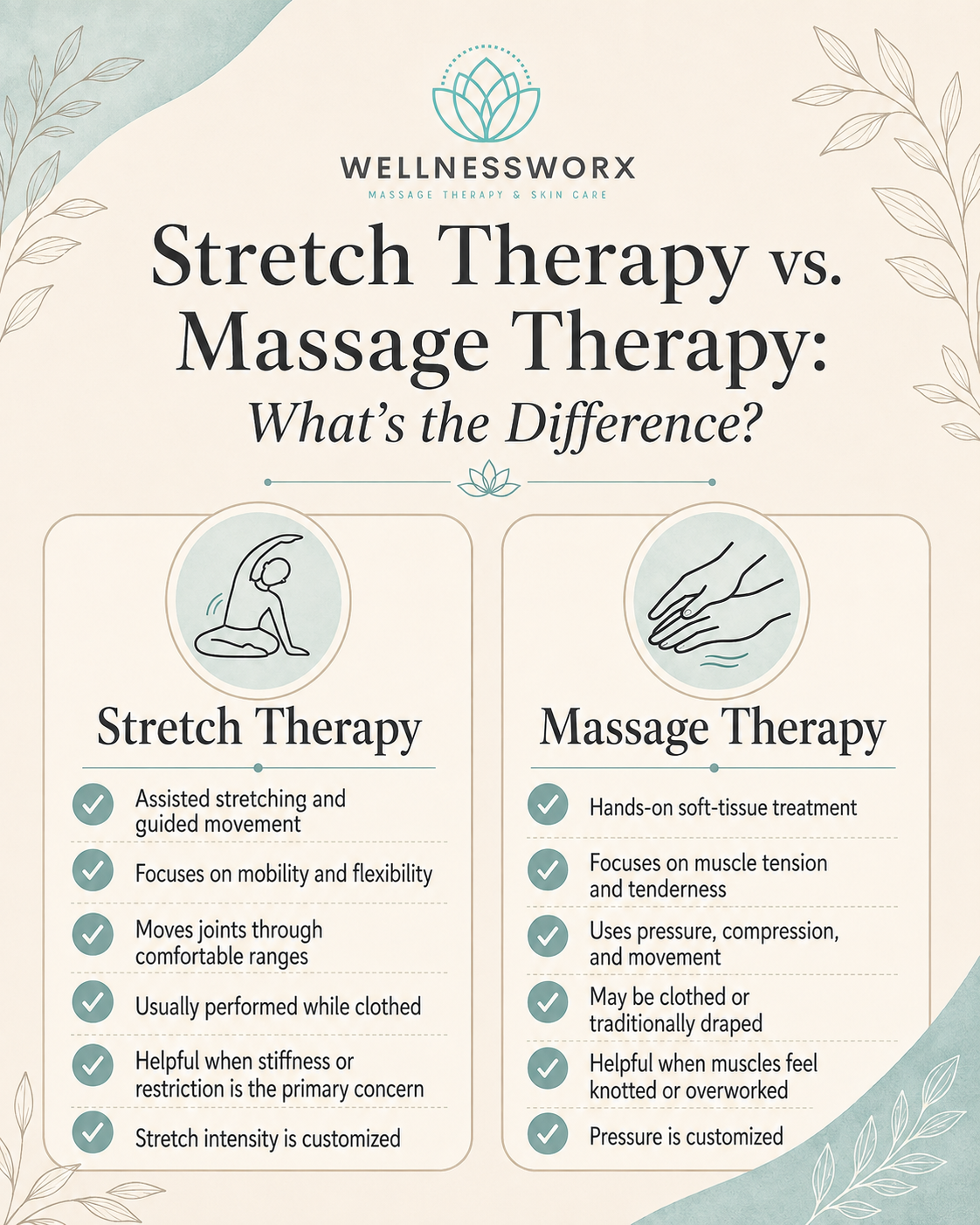
There is significant overlap between the two. A massage session may contain stretching, and stretch therapy may involve hands-on contact with tight tissues.
The primary difference is the main treatment goal and technique.
When Might Stretch Therapy Be a Better Choice?
Stretch therapy may be especially appealing when your main complaint is:
“I feel stiff.”
“I can't move as freely as I used to.”
“My hips and legs always feel tight.”
“I want to work on my flexibility.”
Limited Flexibility
Stretching can temporarily increase range of motion.
A 2023 systematic review and meta-analysis of 47 studies found that a single bout of stretching produced a small but significant improvement in range of motion compared with no stretching. The researchers found improvements across several commonly studied areas, although the effect varied depending on the joint and measurement.
That research examined stretching broadly rather than WellnessWorx-style assisted stretch therapy specifically, so it should not be interpreted as proof that assisted stretching will produce the same result for every client.
General Stiffness
People may feel stiff because of:
Long periods of sitting
Reduced activity
Repetitive movement
Exercise
Aging
Work demands
Postural habits
Muscle guarding
Stretch therapy allows a practitioner to guide the body through controlled movements rather than leaving the client to determine positioning and intensity alone.
Mobility Goals
Range of motion is affected by more than flexibility. Joint structure, muscle extensibility, nervous-system factors, strength, pain, and other variables all contribute.
Recent sports-science literature emphasizes that flexibility and range of motion are related but not identical and that stretching is only one way to influence mobility.
Stretch therapy can therefore be one component of a broader movement plan rather than a guaranteed solution for every mobility restriction.
Desk and Postural Stiffness
People who spend long periods:
Sitting at a computer
Driving
Looking down at a phone
Standing in the same position
Performing repetitive tasks
may begin to feel restricted through the hips, shoulders, chest, or upper back.
Stretch therapy can focus specifically on moving these regions through comfortable ranges.
Active Adults and Athletes
Athletes and active adults may incorporate assisted stretching around training when the goal is maintaining comfortable movement and mobility.
Stretch therapy does not replace:
Strength training
Sport-specific warmups
Physical therapy
Injury rehabilitation
Medical evaluation
but it may complement those activities when appropriate.
When Might Massage Therapy Be a Better Choice?
Massage may be the more natural starting point when your primary complaint is:
“This muscle feels knotted.”
“My shoulders are constantly tense.”
“My back muscles are sore.”
“I want someone to work directly on this tight area.”
Muscle Tension and Knots
Massage allows the therapist to work directly with muscle and soft tissue.
A therapist may use:
Compression
Kneading
Sustained pressure
Trigger-point techniques
Myofascial work
Gentle or deep pressure
to address areas that feel tight or overworked.
Muscle Guarding
When something hurts, nearby muscles may tighten protectively.
Massage may help address some of this surrounding muscle tension when massage is medically appropriate.
Soreness and Recovery
Massage is commonly used by active clients for general muscle soreness, recovery, and tension.
Research on massage has found possible short-term benefits for certain musculoskeletal pain conditions, although the quality of evidence varies and massage should not be described as a cure.
Relaxation
Massage has a clear advantage when your primary goal is:
Relaxation
Stress reduction
General physical tension relief
A calming full-body experience
Stretch therapy may feel good, but it is more movement-oriented and interactive than a typical relaxation massage.
Which Is Better for Tight Muscles?
It depends on what you mean by tight.
If a specific muscle feels:
Knotted
Tender
Overworked
Sore
Guarded
massage may be the more direct option because the therapist can work specifically with that tissue.
If you describe tightness as:
“My hamstrings won't let me bend very far.”
“My hips feel restricted.”
“I can't rotate comfortably.”
“My shoulders don't move the way I'd like.”
stretch therapy may more directly address your movement goal.
In reality, many clients experience both muscular tension and movement restriction, which is why combining approaches can sometimes make sense.
Which Is Better for Flexibility?
Stretch therapy is usually the more direct choice when improving flexibility or comfortable range of motion is the primary goal.
Stretching research consistently shows that stretching can increase range of motion, including immediately after a stretching session.
However, flexibility is not the only contributor to mobility.
For example, limited hip movement might involve:
Muscle extensibility
Joint anatomy
Strength
Pain
Previous injury
Protective guarding
Nervous-system sensitivity
That means repeatedly stretching harder is not always the answer.
A therapist should work within your comfortable range and refer you for appropriate evaluation if the limitation seems unusual, painful, or unrelated to ordinary muscular stiffness.
Which Is Better for Pain?
This question is more complicated.
Massage
Massage has been studied for conditions including:
Lower-back pain
Knee osteoarthritis
Some studies show short-term improvements, but research quality is inconsistent and longer-term benefits are less certain.
Stretch Therapy
Stretching may make movement feel better when stiffness or limited flexibility contributes to discomfort, but assisted stretch therapy should not be presented as a treatment for an undiagnosed pain condition.
If pain—not stiffness—is your primary concern, it is important to determine what may be causing it before aggressively stretching the painful area.
Which Is Better for Limited Mobility?
Stretch therapy may be the more direct option when limited mobility is related primarily to stiffness or flexibility.
Massage may be more appropriate when mobility is being limited partly by:
Painful muscle tension
Muscle guarding
Trigger points
Soft-tissue tenderness
Compensating muscles
Sometimes the therapist may recommend combining both.
For example:
Massage first:
Address highly tense or guarded muscles.
Stretching afterward:
Guide the area through gentle, comfortable movement.
The reverse may also be appropriate depending on the client.
Which Is Better After Exercise?
Both may have a role.
Massage may appeal to you when:
Muscles feel sore
You have localized tension
You want recovery-focused bodywork
You prefer passive treatment
You also want relaxation
Stretch therapy may appeal to you when:
Your body feels stiff after training
You want to work on mobility
Certain ranges of motion feel restricted
You want guided stretching
Flexibility is one of your training goals
Neither should be used to ignore an injury.
Sudden swelling, severe pain, significant weakness, inability to bear weight, joint instability, or symptoms following substantial trauma should be evaluated appropriately.
Is Stretch Therapy Painful?
It should not be.
During assisted stretching, you may feel:
Gentle tension
A pulling sensation
Moderate stretching
Increasing awareness of a tight area
You should not feel:
Sharp pain
Burning
Electric sensations
Increasing numbness
Tingling
Sudden weakness
Joint instability
A sensation that feels alarming
WellnessWorx states that stretch therapy should remain within the client's comfort level, with movements adjusted according to how the body responds.
More stretch does not automatically mean better results.
Does Massage Need to Hurt?
No.
Massage pressure can range from light to firm depending on the client's needs and preferences.
Deep pressure is not automatically more therapeutic.
Tell your massage therapist if you experience:
Sharp pain
Burning
Numbness
Tingling
Weakness
Dizziness
Pain traveling into another area
Pressure that causes you to tense or hold your breath
NCCIH advises people not to use massage to postpone evaluation of a medical problem and recommends discussing massage with a healthcare provider when there is uncertainty about whether treatment is appropriate.
Can Stretch Therapy and Massage Be Combined?
Yes.
For some clients, combining the two approaches makes sense because they address different aspects of movement and muscle tension.
Massage may focus on:
Muscle tension
Soft-tissue tenderness
Guarding
Trigger points
Relaxation
Stretch therapy may focus on:
Flexibility
Stiffness
Comfortable range of motion
Guided movement
Mobility goals
Together they may support:
More comfortable movement
Recovery from everyday physical demands
Mobility work
Active lifestyles
A broader wellness plan
There is no rule that everyone needs both treatments.
The decision should be based on your individual goals and response.
Can You Have Massage and Stretch Therapy During the Same Appointment?
Depending on the service and treatment plan, massage may already incorporate some stretching or mobility work.
WellnessWorx offers massage, stretch therapy, cupping, acupuncture, and other personalized therapeutic services, allowing treatment to be selected based on the client's concerns and goals.
If you are particularly sensitive or new to bodywork, your therapist may recommend gradually introducing different techniques rather than trying to accomplish everything during one session.
Stretch Therapy vs. Massage at a Glance

These ratings are a simplified decision aid—not a measure of guaranteed effectiveness. Individual needs, diagnoses, and treatment responses vary.
How Do You Decide Which One to Book?
Ask yourself what you most want to change.
Consider Stretch Therapy If:
You feel stiff
You want to work on flexibility
Your hips or shoulders feel restricted
You want guided stretching
You want mobility-focused care
Sitting or repetitive activity has left you feeling less mobile
You want support maintaining movement as you age
You prefer to remain clothed during treatment
Consider Massage If:
Your muscles feel knotted or tender
You have recurring muscular tension
Your neck and shoulders feel tight
You want focused soft-tissue work
Your muscles feel sore after activity
You want relaxation
You want medical or therapeutic massage for a specific muscular concern
Consider Both If:
You feel both tight and restricted
Muscle guarding is interfering with movement
You have recovery and mobility goals
Your therapist believes the approaches complement each other
You respond well to both treatments
What Happens During a Stretch Therapy Appointment?
Your first stretch therapy appointment should begin with a conversation about:
Where you feel stiff
Which movements feel restricted
Your activity level
Previous injuries
Joint replacements or surgeries
Medical conditions
Current pain
Numbness or tingling
Your mobility goals
The therapist may then guide you through controlled stretches while monitoring your comfort.
You generally remain clothed, so comfortable clothing that allows easy movement is ideal.
The therapist may adjust:
Your position
Stretch intensity
Range of motion
Duration
Which areas receive attention
WellnessWorx customizes stretch therapy according to each client's body, comfort level, and wellness goals.
What Happens During a Massage Appointment?
Massage also begins with an intake and conversation.
Your therapist may ask about:
Pain and muscle tension
Medical history
Medications
Previous injuries
Surgeries
Sensitivity
Your pressure preferences
Your goals
Treatment may then focus on one or more areas using massage and therapeutic bodywork techniques selected for your needs.
You should communicate throughout treatment if pressure, positioning, or a technique feels uncomfortable.
How Often Should You Schedule Stretch Therapy?
There is no universal schedule.
WellnessWorx notes that some clients working toward flexibility goals may choose weekly or biweekly appointments, while others use stretch therapy less frequently for general movement support.
The appropriate frequency depends on:
Your starting mobility
Your goals
Activity level
Home exercise or stretching
Response to treatment
Medical conditions
Other care you receive
Stretch therapy should complement—not replace—regular movement and appropriate exercise.
How Often Should You Get Massage?
Massage frequency also varies.
Someone may schedule massage:
Occasionally for relaxation
During demanding training periods
When recurring muscle tension develops
As part of a short-term treatment plan
Periodically for maintenance
The best schedule is the one that produces a meaningful benefit without creating unnecessary treatment.
When Should You Speak With a Healthcare Provider First?
Stretching or massage should not be used to push through unexplained symptoms.
Seek medical guidance before treatment if you have:
A recent significant injury
Severe or rapidly worsening pain
New muscle weakness
Increasing numbness or tingling
Joint instability
A recent fracture
Recent surgery with movement restrictions
A suspected blood clot
Significant swelling
An active infection
Severe osteoporosis
A complex medical condition
Medical instructions limiting movement or massage
New neurological symptoms, severe pain, or substantial loss of movement should be evaluated rather than simply stretched or massaged.
Stretch Therapy and Massage Therapy in Glendora, CA
WellnessWorx Massage Therapy & Skin Care provides both personalized massage therapy and stretch therapy in Glendora.
Stretch therapy may be a good fit when your goals involve:
Mobility
Flexibility
Stiffness
Assisted stretching
Comfortable movement
Massage therapy may be a better starting point when your goals involve:
Muscle tension
Muscle knots
Soreness
Guarding
Therapeutic soft-tissue work
Relaxation
And for some clients, the right answer may be both.
WellnessWorx is located at 1200 E Route 66, Suite 115, Glendora, CA 91740 and provides personalized services based on each client's body and wellness goals.
To determine which service may be appropriate for you, call (909) 631-6012 or request an appointment online.
This article is provided for general educational purposes and is not intended to diagnose a condition or replace medical care. New, severe, unexplained, or worsening pain or mobility limitations should be evaluated by an appropriate healthcare professional.
Frequently Asked Questions
-
It depends on how the tightness affects you. Massage may be more direct when a muscle feels knotted, tender, or overworked. Stretch therapy may be more appropriate when the main issue is stiffness, flexibility, or restricted movement. Some clients may benefit from both approaches.
-
Stretching can improve range of motion, and research shows that even a single stretching session may produce small immediate improvements. Individual results vary, and flexibility is only one factor that influences overall mobility.
-
Stretch therapy may be useful when the primary concern is limited hip mobility or flexibility. Massage may be more useful when the hips or glutes feel tender, knotted, or guarded. A therapist can help determine whether one or both approaches fit your goals.
-
Yes. Massage and stretching may complement each other because massage primarily addresses soft-tissue tension while stretch therapy focuses more directly on guided movement and flexibility. Combining them is not necessary for everyone and should be individualized.
-
Typically, stretch therapy is performed while the client remains clothed. Wear comfortable clothing that allows your hips, shoulders, knees, and other joints to move freely. Your therapist can provide specific preparation instructions when you schedule.
