
Can Massage Help Lower-Back Pain? Benefits, Limitations, & What to Expect
Lower-back pain can make ordinary activities—from getting out of bed and driving to sitting at work or exercising—feel much harder than they should.
Sometimes the discomfort begins after lifting, exercise, prolonged sitting, or an awkward movement. In other cases, it develops gradually or keeps returning without one obvious cause.
Massage therapy may help some people with lower-back pain, particularly when muscle tension, stiffness, guarding, or surrounding soft-tissue discomfort are contributing to the problem. Research suggests massage may offer short-term improvements in pain for some people, although the evidence is limited and massage is not appropriate for every cause of back pain.
The key is understanding what massage can realistically address—and recognizing when back pain requires medical evaluation instead.
Why Does the Lower Back Hurt?
“Lower-back pain” describes a symptom, not a single condition.
Pain may involve muscles, ligaments, joints, discs, nerves, or other structures in and around the spine. Sometimes several factors contribute at the same time.
Common contributors may include:
Muscle strain or overuse
Repetitive lifting
Prolonged sitting
Reduced activity
Exercise or sports
Postural strain
Muscle guarding
Previous injuries
Age-related changes in the spine
Disc problems
Arthritis
Sciatica or nerve irritation
Pregnancy-related physical changes
Most episodes of back pain improve over time, but pain that persists, repeatedly returns, travels into the legs, or causes neurological symptoms deserves further evaluation.
Can Massage Help Lower-Back Pain?
Massage may be helpful when part of the discomfort involves the muscles and other soft tissues surrounding the lower back, hips, and pelvis.
Potential goals may include:
Reducing muscle tension
Calming protective muscle guarding
Decreasing stiffness
Helping movement feel more comfortable
Addressing muscles compensating for pain
Supporting relaxation
Providing short-term symptom relief
Complementing physical therapy, exercise, or other care
Research reviews have found that massage may provide short-term improvements for some people with acute and chronic lower-back pain, but the overall quality of the evidence has generally been low. Long-term benefits have not been firmly established.
The American College of Physicians has included massage as one possible non-drug treatment for acute or subacute lower-back pain, based on low-quality evidence. Massage was not specifically recommended in the same guideline as a treatment for chronic lower-back pain.
That does not mean massage cannot feel helpful for someone with chronic pain. It means the research does not support presenting massage as a proven long-term solution.
What Massage May Help With—and What It Cannot Fix
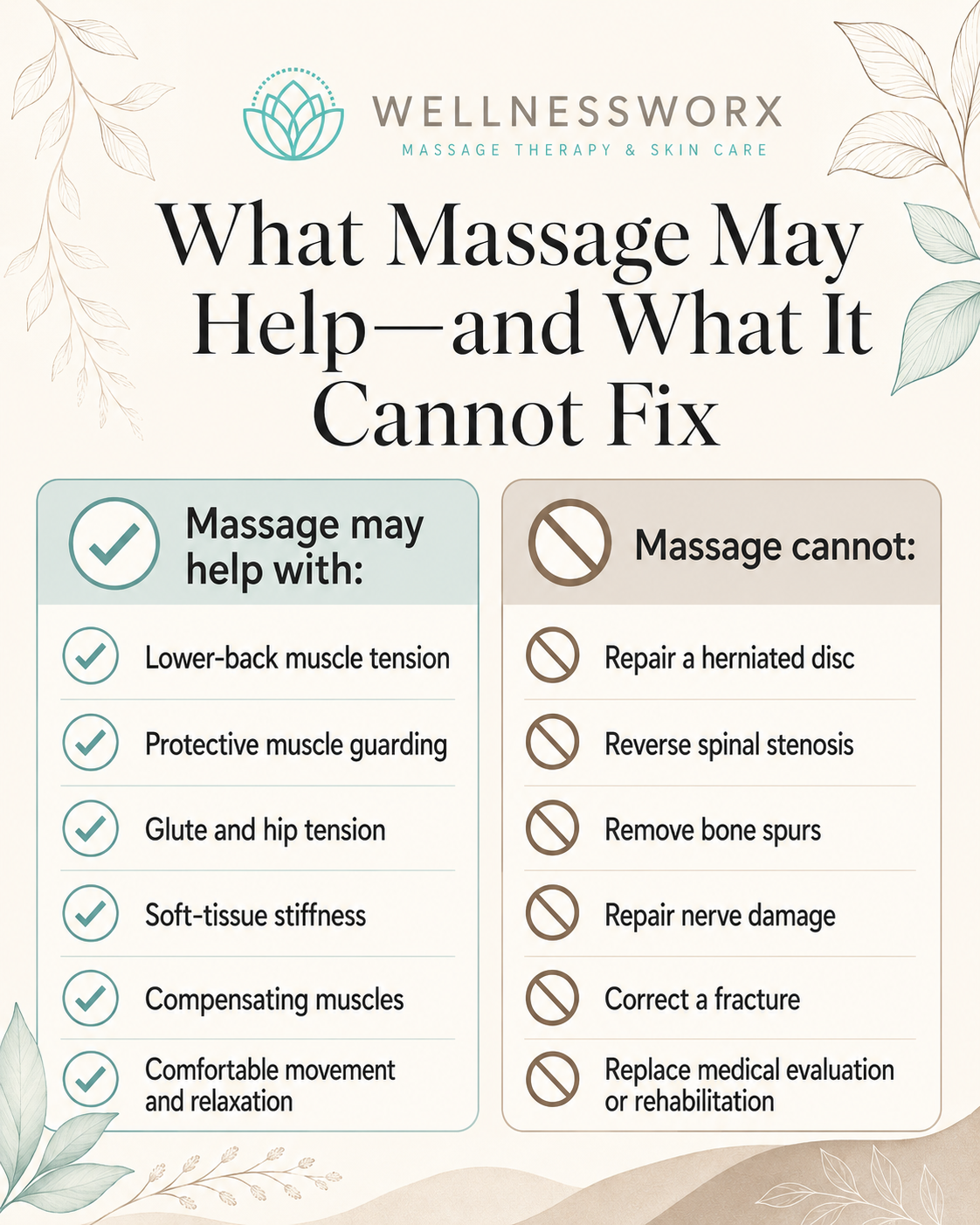
Understanding this distinction is especially important with back pain.
Massage may help with:
Tight lower-back muscles
Glute and hip tension
Muscle guarding
Stiffness associated with inactivity
Compensating muscles
Postural muscle fatigue
Soft-tissue tenderness
General relaxation and comfort
Movement restricted partly by muscular tension
Massage cannot:
Repair a herniated disc
Reverse spinal stenosis
Remove bone spurs
Repair damaged nerves
Correct a fracture
Diagnose the cause of back pain
Guarantee pain will disappear
Replace medically necessary physical therapy, imaging, medication, injections, or surgery
Massage works primarily with muscles and other soft tissues. The treatment plan should therefore depend on what is actually contributing to your symptoms.
How May Massage Support Lower-Back Pain?
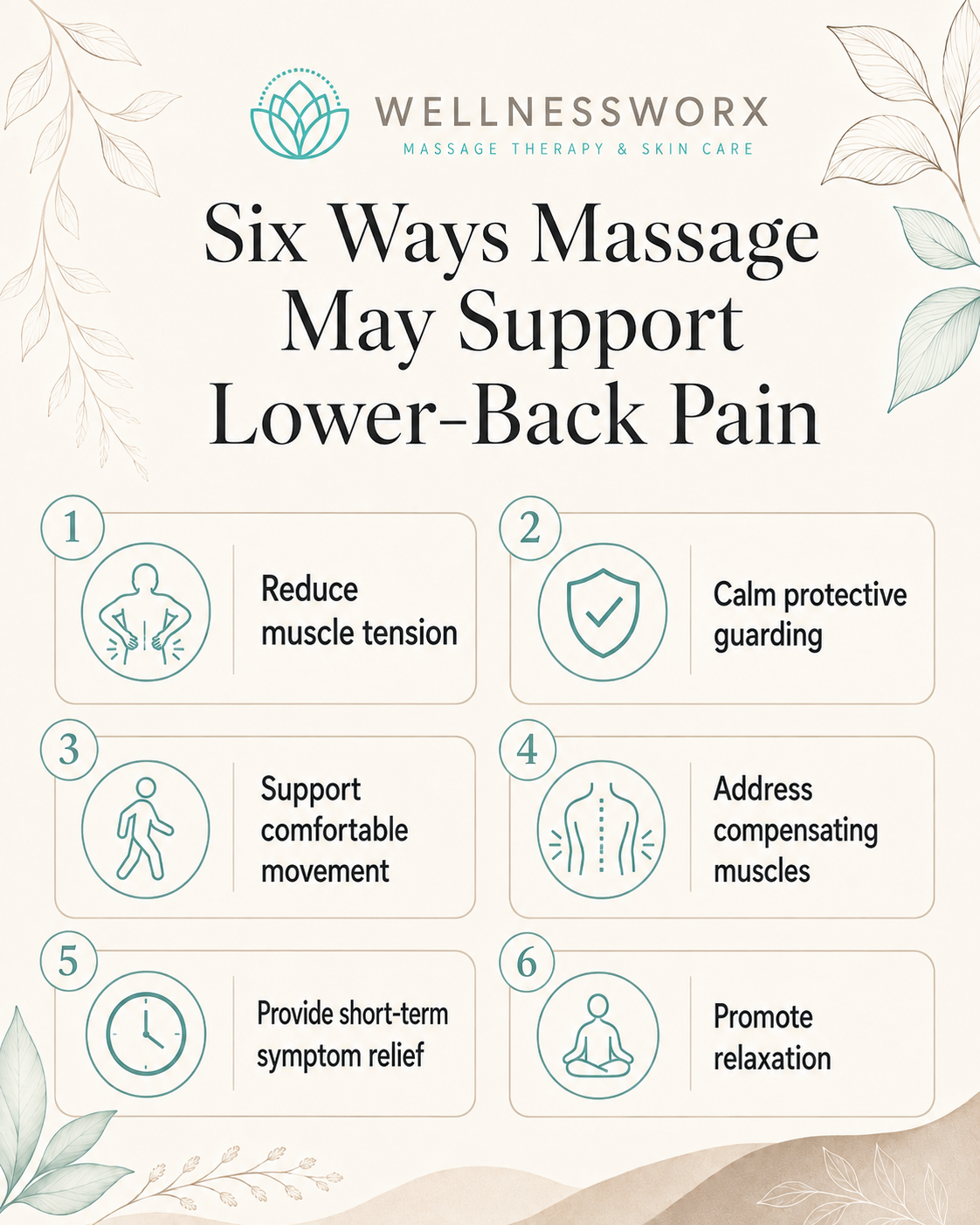
1. It May Reduce Muscle Tension
The lower back contains muscles that help stabilize the spine and support bending, twisting, standing, and lifting.
When these muscles become overworked or remain tense for long periods, they may feel sore, tight, or fatigued.
Massage may help some of these tissues relax, particularly when the discomfort is related to overuse, repetitive activity, or prolonged positioning.
Treatment may also address the hips and glutes because these muscles work closely with the lower back during everyday movement.
2. It May Calm Protective Muscle Guarding
Pain often causes the body to tense automatically.
This protective response—sometimes called muscle guarding—may initially help limit uncomfortable movement. When guarding continues, however, the surrounding muscles can become fatigued and stiff.
Massage may help reduce some of this muscular tension, making it easier for certain clients to move without feeling as guarded.
The goal should not be to force the muscles to relax through painful pressure. Treatment should remain within the client's tolerance.
3. It May Help Movement Feel More Comfortable
Back pain can make it difficult to:
Bend forward
Rotate
Stand from a chair
Walk
Reach
Exercise
Get in and out of a vehicle
Change positions in bed
If muscle tension contributes to those restrictions, massage may help make some movements feel easier.
Massage cannot restore movement that is limited by every structural or neurological condition. For persistent limitations, physical therapy, exercise, or another medical treatment may be necessary.
4. It May Address Compensating Muscles
People naturally change how they move when something hurts.
Someone with lower-back pain may:
Shift more weight to one side
Walk differently
Avoid bending
Hold the torso rigid
Sit unevenly
Use the hips differently
Overwork muscles higher in the back
This compensation can create tension in areas that were not originally painful.
A customized massage may therefore address the:
Lower back
Glutes
Hips
Outer hip muscles
Hamstrings
Upper back
Muscles on the opposite side of the body
The most painful area is not always the only area that needs attention.
5. It May Provide Short-Term Pain Relief
A review of studies involving roughly 3,000 participants found that massage may produce short-term improvements in lower-back pain, although researchers rated the evidence as low to very low quality.
Even short-term relief can be useful.
A period of improved comfort may make it easier to:
Complete physical-therapy exercises
Walk
Return to gentle activity
Sleep
Work
Stretch
Change positions more comfortably
Massage should therefore be viewed as one potential tool rather than the entire treatment plan.
6. It May Promote Relaxation
Back pain can make it difficult to relax because the body may remain tense in anticipation of movement or discomfort.
The predictable pressure and rhythm of massage may help reduce generalized physical tension.
This does not mean lower-back pain is “just stress.” Pain is real, and relaxation is simply one way supportive care may help someone feel more comfortable while other aspects of the condition are addressed.
Acute vs. Chronic Lower-Back Pain
The duration of back pain matters.
Acute lower-back pain
Acute back pain generally begins suddenly and may occur after:
Lifting
Exercise
An awkward movement
Overuse
A minor strain
Many cases improve within days or weeks.
Research suggests massage may be one option for some cases of acute or subacute lower-back pain when serious injury has been ruled out.
Chronic lower-back pain
Chronic lower-back pain continues for an extended period or repeatedly returns.
It can become more complex because factors such as movement habits, sleep, activity, stress, nervous-system sensitivity, previous injuries, and underlying medical conditions may all contribute.
Evidence supporting massage for chronic lower-back pain is less certain. Some studies show modest short-term benefits, but long-term effects have not been established.
Chronic pain often benefits from a broader management strategy rather than relying on massage alone.
What Areas Might a Massage Therapist Work On?
A lower-back massage appointment does not necessarily mean the therapist will spend the entire session directly pressing on the lumbar spine.
Depending on your symptoms, treatment may include muscles around the:
Lower back
Sacrum
Glutes
Hips
Hip rotators
Outer thighs
Hamstrings
Upper back
Abdomen or hip flexor region when appropriate and within scope
Your therapist may also work on areas that are compensating for the painful region.
Treatment should avoid aggressive pressure directly over bones or areas where pressure reproduces neurological symptoms.
What Massage Techniques May Be Used?
There is no single “best” massage technique for lower-back pain.
Research has not established that one massage style is consistently more effective than another.
Depending on your symptoms and comfort, a session may include:
General therapeutic massage
Myofascial techniques
Trigger-point work
Carefully selected deep-tissue techniques
Mobility-focused bodywork
Focused work around the hips and glutes
Relaxation techniques
The therapist should choose techniques according to your body and treatment goals rather than automatically using deep pressure.
Is Deep-Tissue Massage Good for Lower-Back Pain?
Sometimes—but deeper is not always better.
Firm pressure may be useful when deeper muscular tension contributes to discomfort. However, aggressive deep-tissue work can be inappropriate when:
The area is acutely irritated
Symptoms include nerve pain
There has been recent trauma
The client bruises easily
A medical condition makes deep pressure unsafe
Pressure causes the body to guard further
People taking anticoagulant medication or living with certain bleeding conditions should generally avoid forceful massage unless appropriately cleared.
Your therapist may begin with lighter or moderate pressure and adjust based on your response.
Does Massage for Back Pain Need to Hurt?
No.
Some tight or tender areas may feel sensitive during treatment, but massage does not need to be extremely painful to be useful.
Tell your therapist immediately if you experience:
Sharp pain
Burning
Electric sensations
Increased numbness
Tingling
Weakness
Pain traveling farther down a leg
Dizziness
Nausea
A sensation that feels unusual or alarming
Pain that radiates into the leg may indicate nerve involvement and should not simply be “worked through.”
What About Sciatica?
Lower-back pain and sciatica often occur together, but they are not the same thing.
Sciatica refers to symptoms involving irritation or compression of the sciatic nerve or the nerve roots that form it.
Symptoms may include:
Pain traveling through the buttock and leg
Burning
Tingling
Numbness
Leg or foot weakness
Massage may help some of the muscular tension surrounding sciatica, but it cannot remove a herniated disc, widen spinal stenosis, or directly repair nerve damage.
If your back pain travels down the leg or involves numbness or weakness, medical evaluation is especially important.
What Happens During a Lower-Back Massage Appointment?
Your therapist should begin by learning more about your symptoms rather than immediately starting treatment.
You may be asked:
Where does the pain occur?
When did it begin?
Was there an injury?
Does the pain stay in your back or travel elsewhere?
Do you experience numbness or tingling?
Does either leg feel weak?
Which movements make it worse?
Which positions feel better?
Have you been medically evaluated?
Have you had imaging?
Are you receiving physical therapy?
What medications do you take?
What would you like to be able to do more comfortably?
At WellnessWorx, massage and therapeutic bodywork are personalized for clients experiencing concerns such as back pain, chronic tension, injuries, stiffness, and limited mobility rather than following one standard routine for every client.
How Will You Be Positioned?
You do not necessarily have to lie face down.
Depending on what feels best for your back, you may be positioned:
Face down
Face up
Side-lying
Partially elevated
With a pillow beneath the knees
With bolsters supporting the hips or ankles
Tell your therapist immediately if the position increases your pain.
For some clients with lower-back pain, side-lying or lying face up with the knees supported may feel better than remaining face down for an extended period.
How Is the Pressure Chosen?
Pressure should be based on:
Your sensitivity
The cause of your symptoms
How long the pain has been present
Whether nerve symptoms are present
Your health history
The specific treatment area
How the tissues respond during the session
A medical massage appointment does not automatically mean firm pressure.
Some clients may benefit from deeper work, while others respond better to gentle or moderate techniques.
Communication throughout treatment is important.
How Many Sessions Might You Need?
There is no universal number of massage sessions for lower-back pain.
Frequency depends on:
How long symptoms have been present
The underlying cause
Your activity level
Your response to treatment
Other care you are receiving
Your functional goals
Your budget and schedule
Some people notice temporary improvement after one appointment. Others may use several sessions as part of a broader treatment plan.
A responsible therapist should reassess whether the massage is producing meaningful changes rather than promising that a specific number of treatments will “fix” your back.
What Can You Do Between Massage Appointments?
Follow the recommendations of your healthcare provider, physical therapist, or other treating professional.
Depending on your condition, supportive strategies may include:
Staying gently active
Changing positions regularly
Completing prescribed exercises
Gradually returning to normal activity
Improving workstation ergonomics
Using heat or cold when appropriate
Avoiding repeated movements that clearly aggravate symptoms
Strengthening the muscles supporting the trunk and hips
Prolonged bed rest is generally not recommended for uncomplicated back pain. Mayo Clinic notes that most back pain improves over time and that staying appropriately active is usually preferable to extended bed rest.
When Should You See a Healthcare Professional Before Massage?
Medical evaluation is recommended when lower-back pain:
Persists for several weeks
Is severe or progressively worsening
Does not improve with rest or self-care
Travels down one or both legs
Extends below the knee
Causes numbness or tingling
Causes leg weakness
Occurs with unexplained weight loss
Began after a fall, accident, or other significant trauma
Is substantially worse at night or while resting
These symptoms do not automatically mean something serious is wrong, but they warrant further evaluation before assuming the problem is simply muscular.
When Is Lower-Back Pain an Emergency?
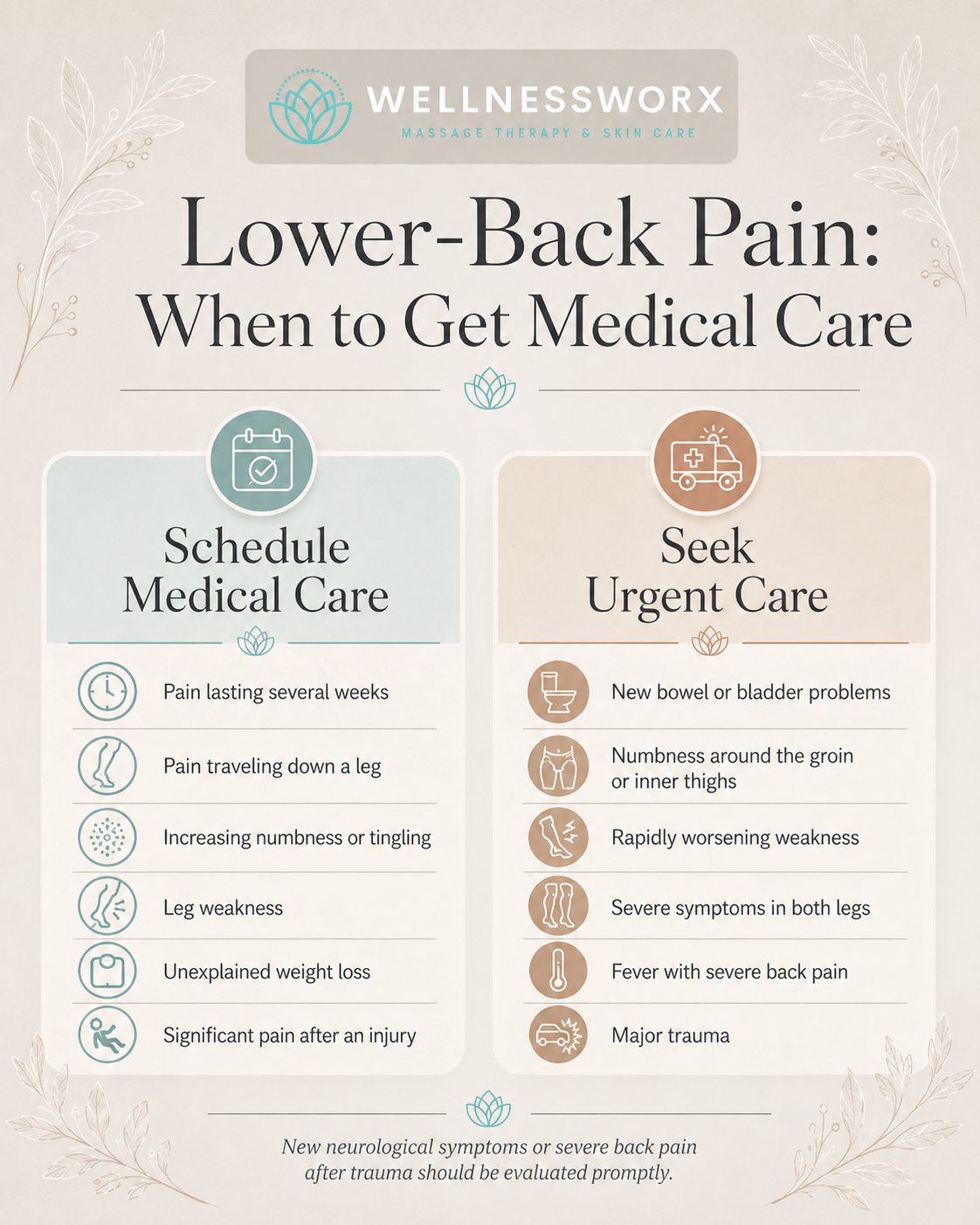
Seek immediate medical care for back pain associated with:
New loss of bladder control
New loss of bowel control
Numbness around the groin, inner thighs, or saddle region
Rapidly worsening leg weakness
Severe symptoms affecting both legs
Fever with significant back pain
Major trauma
Difficulty walking caused by sudden weakness or loss of coordination
New bowel or bladder problems, neurological changes, or severe back pain following trauma can indicate a condition that requires urgent medical care rather than massage.
Massage for Lower-Back Pain in Glendora, CA
WellnessWorx Massage Therapy & Skin Care provides personalized massage and therapeutic bodywork in Glendora for clients experiencing back pain, chronic muscle tension, stiffness, limited mobility, and injury-related discomfort.
Instead of following a standard full-body routine, treatment can be customized around your:
Symptoms
Health history
Pressure tolerance
Areas of muscle tension
Movement limitations
Treatment goals
Depending on your needs, your therapist may incorporate medical massage, deep-tissue techniques, trigger-point work, stretching, mobility-focused bodywork, or relaxation techniques.
WellnessWorx is located at 1200 E Route 66, Suite 115, Glendora, CA 91740 and provides care for clients throughout Glendora and surrounding communities.
To ask whether massage may be appropriate for your lower-back discomfort, call (909) 631-6012 or request an appointment online.
This article is provided for general educational purposes and is not intended to diagnose the cause of back pain or replace medical care. New, severe, unexplained, worsening, or neurological symptoms should be evaluated by an appropriate healthcare professional.
Frequently Asked Questions
-
No. Massage cannot guarantee that lower-back pain will disappear or correct every underlying condition. It may help reduce muscle tension, guarding, stiffness, and certain soft-tissue symptoms while supporting more comfortable movement.
-
There is no single massage technique proven to be best for all lower-back pain. Treatment may include medical massage, therapeutic massage, myofascial techniques, trigger-point work, stretching, or carefully selected deep-tissue techniques depending on your symptoms and comfort.
-
Not necessarily. Your therapist may also address the glutes, hips, hamstrings, upper back, or other muscles that are contributing to tension or compensating for your pain. Direct pressure should be modified or avoided if it increases symptoms.
-
It can. Excessive pressure, uncomfortable positioning, or treatment of an undiagnosed injury may aggravate symptoms. Tell your therapist immediately about sharp pain, increasing numbness or tingling, weakness, or pain traveling farther down the leg.
-
Medical evaluation is particularly important when pain is severe, persistent, worsening, follows significant trauma, travels down the legs, or causes numbness or weakness. Seek urgent care for new bowel or bladder problems, rapidly worsening weakness, fever with severe back pain, or numbness around the groin or inner thighs.
