
Can Massage Help Tension Headaches?
Tension headaches can feel like a dull ache, steady pressure, or a tight band wrapped around the head. The discomfort may also involve tenderness around the scalp, temples, neck, or shoulders.
Massage therapy may help some people manage tension headaches when tight or tender muscles, stress, posture, jaw clenching, or neck and shoulder tension are contributing to their discomfort. However, headache symptoms can have many different causes, and massage should not be treated as a guaranteed cure or a substitute for medical evaluation.
Research on massage for headaches is still limited and has produced inconsistent results. When massage is appropriate, its most realistic role is to support relaxation, address surrounding muscle tension, improve neck and shoulder comfort, and complement a broader headache-management plan.
What Is a Tension-Type Headache?
A tension-type headache is a common type of headache that usually causes mild to moderate pressure or aching around the head.
Despite the name, researchers do not believe tension headaches are caused simply by muscles contracting because someone feels stressed. The exact cause is not fully understood. Increased sensitivity to pain may play a role, and muscle tenderness around the head, neck, and shoulders is common in people who experience tension-type headaches.
Tension-type headaches may be occasional, frequent, or chronic. Some last for less than an hour, while others continue much longer. A healthcare professional can help determine the type of headache when symptoms are recurring, changing, or disrupting daily life.
What Does a Tension Headache Feel Like?
Common features may include:
Dull, aching, or pressure-like pain
A sensation of a tight band around the head
Pain on both sides of the head
Tenderness around the scalp or temples
Tightness at the base of the skull
Neck and shoulder tenderness
Mild to moderate pain
Discomfort that is not strongly worsened by normal daily activity
Tension headaches usually do not cause the nausea or vomiting commonly associated with some migraines. Headache patterns vary, however, and symptoms can overlap.
Tension Headache vs. Migraine: What Is the Difference?
It is important not to assume that every headache caused by stress or neck tightness is a tension headache.
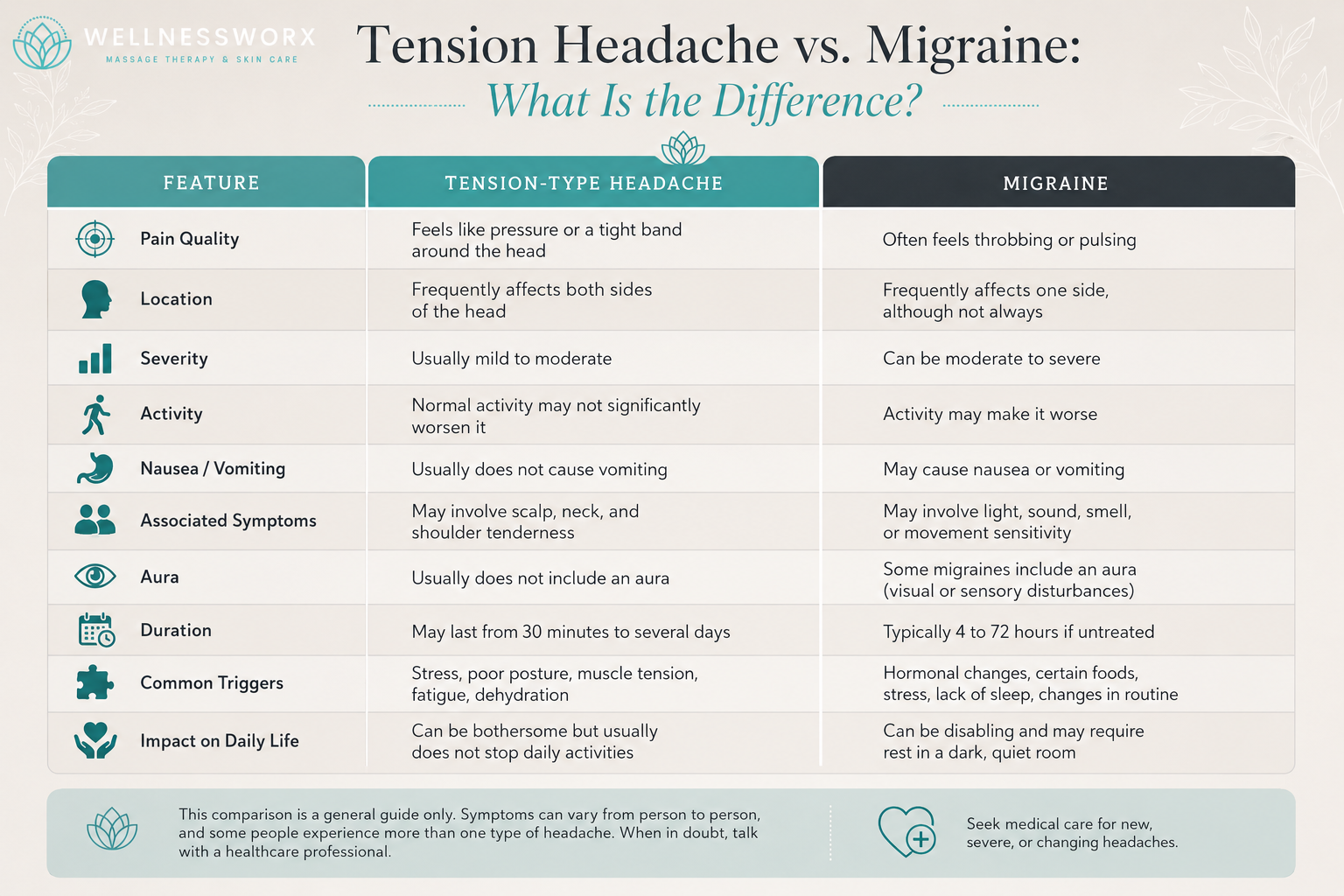
This comparison is only a general guide. Some migraines do not have classic migraine features, and people can experience more than one type of headache. A healthcare professional should evaluate new, frequent, severe, or changing headaches.
Can Massage Help Tension Headaches?
Massage may help some people with tension-type headaches, especially when they also experience tight or tender muscles around the neck, shoulders, scalp, or base of the skull.
Potential goals of massage may include:
Reducing surrounding muscle tension
Addressing tender areas in the neck and shoulders
Supporting relaxation
Improving comfort while moving the neck
Reducing postural strain
Helping the client recognize where they hold tension
Complementing provider-recommended headache care
The research is not conclusive. Only a small number of massage studies have focused on headaches, and the results have not been consistent. In one study of people with tension headaches, both the massage group and an inactive-treatment group experienced fewer headaches, but massage did not perform better than the inactive treatment. A broader review found that manual therapies may be useful non-drug options for some people with tension-type headaches, but more high-quality research is needed.
Massage should therefore be presented as a supportive option—not a treatment guaranteed to stop or prevent headaches.
How May Massage Support Tension-Headache Management?
1. It May Address Neck and Shoulder Tenderness
People with tension-type headaches frequently experience tenderness around the back of the head, neck, scalp, and shoulders.
A massage therapist may carefully work with muscles that feel tight, fatigued, or sensitive. This may be especially useful for clients who spend long periods sitting, driving, using a computer, or looking down at a phone.
Massage may improve the comfort of the surrounding muscles even when it does not remove the underlying reason headaches are occurring.
2. It May Reduce Tension at the Base of the Skull
Small muscles at the base of the skull help control head and neck movement. These tissues may feel tender or overworked when someone holds their head in one position for long periods.
Gentle treatment around the upper neck and base of the skull may help reduce some of that muscular tension. The therapist should avoid forceful pressure or aggressive neck manipulation.
3. It May Support Relaxation
Stress does not explain every tension headache, but emotional strain, fatigue, anxiety, and demanding routines can be associated with headache episodes.
The steady rhythm and predictable pressure of massage may help the client feel calmer and less physically guarded. Relaxation-based techniques may be incorporated even when the primary session goal is focused therapeutic care.
4. It May Address Posture-Related Muscle Tension
Holding the head and neck in one position for long periods may contribute to discomfort around the neck, scalp, and shoulders.
A massage session may focus on areas affected by sustained posture, including the:
Upper shoulders
Upper back
Neck
Muscles around the shoulder blades
Chest
Base of the skull
Massage does not permanently correct posture. It may, however, help address some of the muscle tension associated with prolonged sitting or repetitive positioning.
5. It May Help With Jaw-Related Muscle Tension
Jaw clenching and teeth grinding may contribute to discomfort around the temples, jaw, face, neck, and head.
When appropriate and within the therapist’s training, treatment may include external work around the jaw, temples, neck, and upper shoulders. Clients with significant jaw pain, dental symptoms, or suspected temporomandibular joint problems should also speak with a dentist or appropriate healthcare provider.
What Massage Can and Cannot Do
Massage may help with:
Tight or tender neck muscles
Upper-shoulder tension
Muscle guarding
Tenderness around the base of the skull
General stress and physical tension
Posture-related muscle fatigue
Jaw and temple tension
Relaxation and daily comfort
Massage cannot:
Diagnose the cause of a headache
Guarantee that headaches will stop
Treat a brain injury, aneurysm, infection, or neurological emergency
Replace medically necessary medication or evaluation
Determine whether a headache is a migraine
Correct every postural or structural concern
Safely treat a new headache after a head injury without medical guidance
Massage may support the muscles surrounding the head and neck, but treatment decisions should be based on the type and cause of the headache.
Which Areas May Be Addressed During the Session?
Depending on the client’s symptoms, a therapist may focus on the:
Upper back
Shoulders
Neck
Base of the skull
Scalp
Temples
Muscles around the shoulder blades
Upper chest
External jaw muscles
The therapist may spend more time on the neck and shoulders than on the head itself. Treatment should be customized according to the client’s sensitivity, headache pattern, health history, and comfort.
What Massage Techniques May Be Used?
A massage appointment for headache-related tension may include:
Gentle therapeutic massage
Myofascial techniques
Trigger-point work
Scalp massage
Gentle treatment around the base of the skull
External jaw and temple massage
Light stretching
Relaxation and breathing techniques
No single massage technique has been established as best for tension headaches. The appropriate approach depends on the client and how the body responds.
Does Headache Massage Need to Hurt?
No. Massage for tension headaches should not require aggressive pressure.
Neck, shoulder, scalp, and jaw muscles may feel tender, but excessive pressure can cause the client to tense further or may increase discomfort.
Tell your therapist immediately if treatment causes:
A sudden increase in headache pain
Dizziness
Nausea
Blurred or double vision
Numbness or tingling
Weakness
Sharp or shooting pain
Confusion
Lightheadedness
A sensation that feels unusual or alarming
The therapist may need to reduce pressure, change your position, avoid an area, stop treatment, or recommend medical evaluation.
What Happens During a Tension-Headache Massage Appointment?
The appointment should begin with a conversation about your symptoms and health history.
Your therapist may ask:
Where the headache begins
Whether it affects one side or both sides
What the pain feels like
How often headaches occur
How long they usually last
Whether you experience nausea, visual changes, or light sensitivity
Whether your neck or shoulders feel tight
Whether you clench or grind your teeth
Whether headaches began after an injury
Which medications you use
Whether a healthcare professional has diagnosed the headache type
What makes your symptoms better or worse
Treatment may be performed face down, face up, side-lying, seated, or partially elevated. The therapist may use pillows and bolsters to support the neck and reduce pressure on sensitive areas.
The session may focus primarily on the upper back, neck, shoulders, scalp, or jaw rather than following a standard full-body routine.
How Many Massage Sessions Might You Need?
There is no universal number of massage sessions for tension headaches.
The appropriate frequency depends on:
How often the headaches occur
Whether muscle tenderness is present
The client’s response to treatment
Medical recommendations
Work and postural demands
Stress and sleep patterns
Other care the client is receiving
Treatment goals and budget
Some clients may notice temporary relief after one appointment. Others may choose a short series of sessions to determine whether massage produces a meaningful change in headache frequency, comfort, or function.
A responsible therapist should reassess the approach rather than promising that a set number of appointments will eliminate headaches.
What Can You Do Between Appointments?
A healthcare professional may recommend keeping a headache diary to track:
When headaches occur
How long they last
Where the pain is located
Possible triggers
Sleep
Stress
Meals
Caffeine
Medications
Menstrual-cycle patterns
Activities completed before the headache began
Other strategies may include stress management, regular breaks from screens, improving workstation positioning, heat or cold on tender muscles, rest, and following medication instructions from a healthcare professional. Frequent use of pain medication can sometimes contribute to medication-overuse or rebound headaches, so recurring medication use should be discussed with a provider.
When Should You Speak With a Healthcare Professional?
Schedule a medical appointment when:
Headaches frequently disrupt your life
Your headache pattern changes
Headaches suddenly feel different
You need pain medicine several times a week
Treatment that previously helped stops working
Headaches are becoming more frequent or severe
You are uncertain whether the headaches are tension headaches or migraines
Headaches are associated with recurring dizziness, visual symptoms, or neurological concerns
Recurring headaches deserve an accurate diagnosis before they are treated only as muscle tension.
When Is a Headache an Emergency?
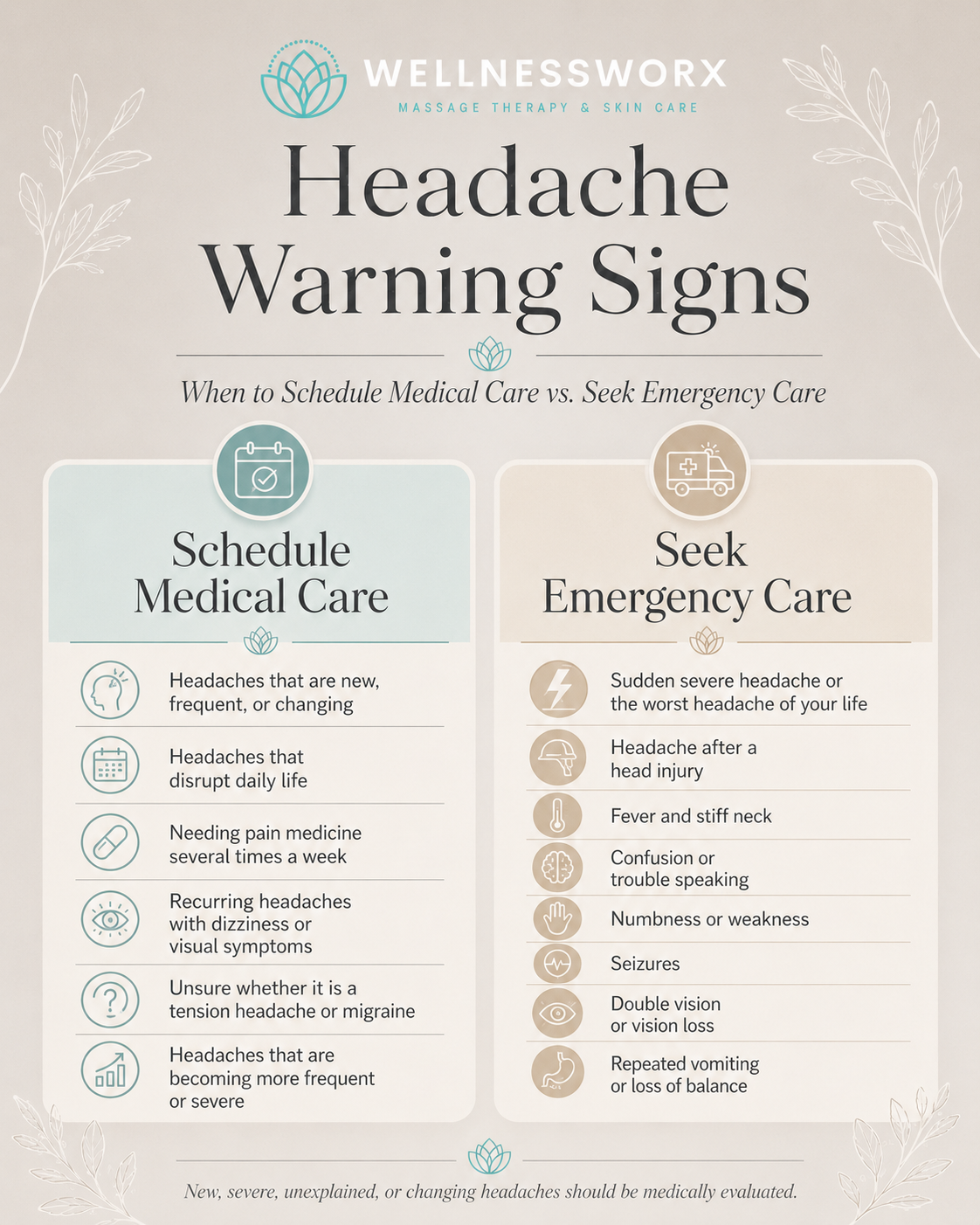
Seek emergency care for:
A sudden, extremely severe headache
A headache described as the worst of your life
Headache with a fever and stiff neck
Confusion
Seizures
Double vision
Trouble speaking
Numbness or weakness
Loss of balance or coordination
Repeated vomiting
A worsening headache after a head injury
These symptoms may indicate a serious condition that requires immediate medical evaluation rather than massage therapy.
Massage for Tension Headaches in Glendora, CA
WellnessWorx Massage Therapy & Skin Care provides personalized massage therapy in Glendora for clients experiencing neck and shoulder tension, recurring muscle tightness, stress-related discomfort, limited mobility, and headaches associated with muscular tension.
Each session is customized around your symptoms, health history, pressure tolerance, and treatment goals. Depending on your needs, treatment may include medical massage, focused neck and shoulder work, gentle scalp massage, trigger-point techniques, stretching, or relaxation-based massage.
To ask whether massage may be appropriate for your headache-related tension, call (909) 631-6012 or request an appointment online.
This article is provided for general educational purposes and is not intended to diagnose a headache disorder or replace medical care. New, severe, unexplained, changing, or injury-related headaches should be evaluated by an appropriate healthcare professional.
Frequently Asked Questions
-
Massage cannot be guaranteed to stop or cure tension headaches. It may help reduce surrounding neck, shoulder, scalp, or jaw tension and support relaxation. Results vary, and recurring headaches should be evaluated by a healthcare professional.
-
Treatment may focus on the upper back, shoulders, neck, base of the skull, scalp, temples, chest, or external jaw muscles. The areas selected should be based on the client’s symptoms, sensitivity, health history, and comfort.
-
Deep pressure may help some tight muscles, but it is not necessary or appropriate for everyone. Sensitive neck, scalp, and jaw tissues may respond better to light or moderate pressure. Treatment should be adjusted if pressure increases headache pain or causes dizziness, numbness, or nausea.
-
Yes. A headache may worsen if pressure is too intense, positioning is uncomfortable, or the headache has a cause that is not appropriate for massage. Tell the therapist immediately if symptoms increase or if you experience visual changes, weakness, numbness, confusion, or severe pain.
-
Medical evaluation is recommended when headaches are new, frequent, severe, changing, or associated with neurological symptoms. Seek emergency care for a sudden severe headache, headache after a head injury, or headache with fever, stiff neck, confusion, weakness, numbness, seizures, or trouble speaking.
