
How Medical Massage May Support Chronic Pain Management

Chronic pain can affect far more than one part of the body. It may interfere with sleep, mobility, work, exercise, concentration, relationships, and the ability to enjoy everyday activities.
The Centers for Disease Control and Prevention defines chronic pain as pain lasting longer than three months. It may be connected to an injury, health condition, inflammation, medical treatment, or a cause that is not clearly understood. In 2023, approximately 24% of U.S. adults reported experiencing chronic pain.
Medical massage may provide supportive care for some people experiencing chronic pain—particularly when muscle tension, protective guarding, stiffness, or limited movement are contributing to their discomfort.
It is not a cure for chronic pain, and it cannot correct every underlying medical condition. However, when massage is appropriate, a personalized treatment plan may help reduce soft-tissue tension, improve daily comfort, support movement, and complement care from physicians, physical therapists, and other healthcare professionals.
What Is Medical Massage?
Medical massage is a focused, goal-oriented form of massage therapy designed around a specific concern rather than a standard relaxation routine.
A medical massage appointment may focus on:
A particular area of pain or tension
Movement that feels restricted
Muscles compensating for an injury or condition
Recurring patterns of tightness
Comfort during everyday activities
Progress toward a functional goal
Recommendations from another healthcare provider
At WellnessWorx, medical massage sessions are personalized according to the client’s symptoms, health history, mobility, comfort level, and treatment goals. The clinic’s medical massage service is intended for concerns that may include chronic pain, muscle tension, back and neck discomfort, sciatica, injury recovery, and limited mobility.
Medical massage does not mean that the therapist diagnoses a medical condition. Massage therapists work with muscles and other soft tissues within their professional scope and may coordinate with a client’s established healthcare plan when appropriate.
How Is Medical Massage Different From a Relaxation Massage?
Both medical massage and relaxation massage can be valuable, but they usually begin with different goals.
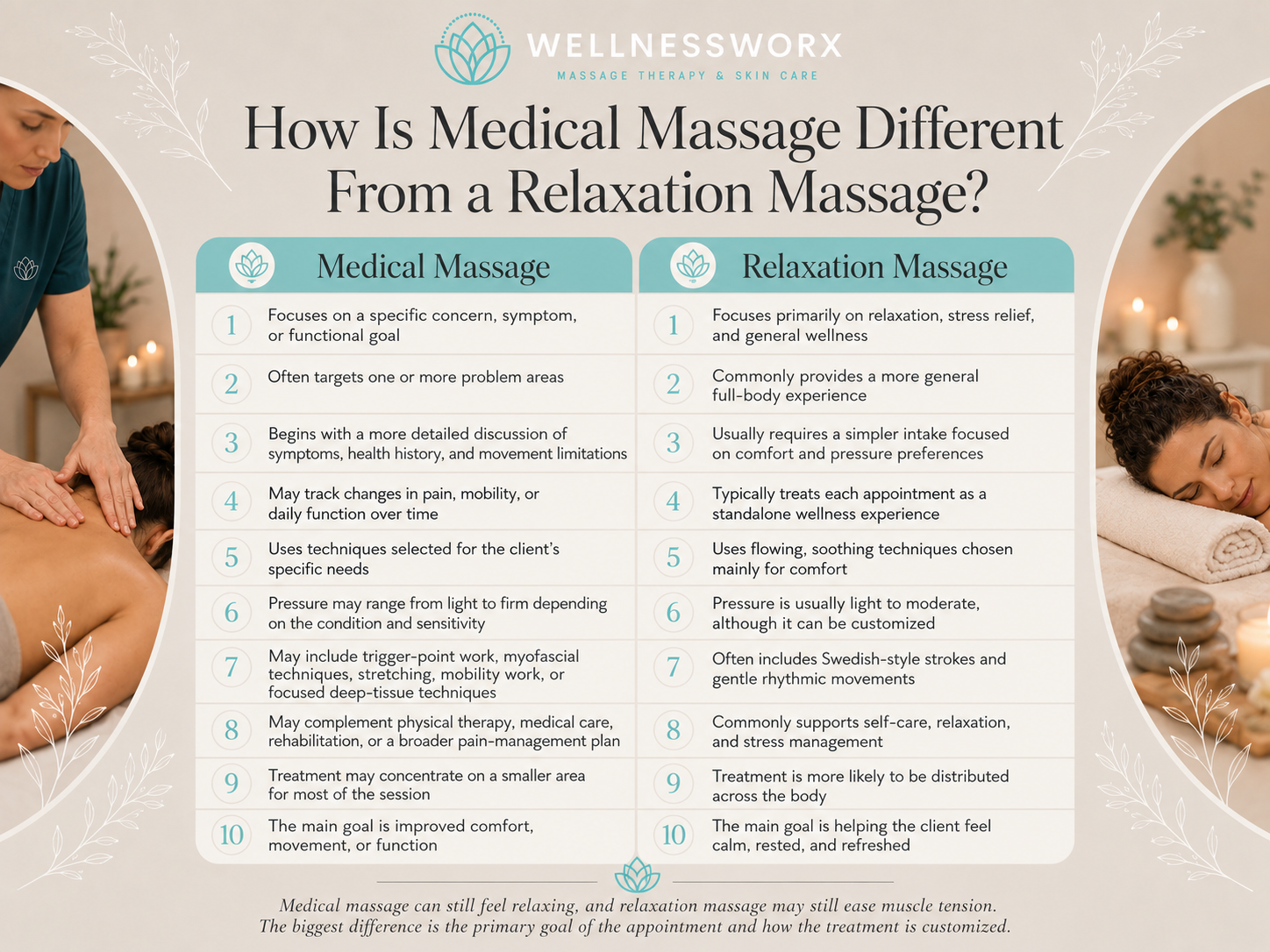
A medical massage may still feel relaxing, and a relaxation massage may still ease muscle tension. The primary difference is the reason for treatment and how the session is customized.
What Is Chronic Pain?
Chronic pain is pain that continues or repeatedly returns for more than three months. It may develop after an injury, occur alongside an ongoing health condition, or remain even after the original tissues have healed.
It may be associated with concerns such as:
Chronic lower-back discomfort
Neck and shoulder pain
Arthritis-related pain and stiffness
Fibromyalgia
Myofascial pain
Repetitive-use strain
Previous injuries
Postural stress
Sciatica-related symptoms
Muscle tension and limited mobility
Chronic pain is not experienced the same way by every person. It may feel dull, aching, tight, burning, tender, sharp, or unusually sensitive. Symptoms may remain constant or fluctuate depending on activity, sleep, stress, positioning, and the underlying condition.
Because chronic pain can have many possible causes, new or unexplained symptoms should be medically evaluated rather than automatically assumed to be muscular.
Can Medical Massage Help Chronic Pain?
Research suggests massage may provide pain relief or functional benefits for some conditions, but the strength of the evidence varies.
The National Center for Complementary and Integrative Health reports that massage may offer short-term benefits for some neck, shoulder, lower-back, knee osteoarthritis, and fibromyalgia symptoms. However, much of the research is limited, and long-term benefits have not been firmly established.
A 2024 review that examined systematic reviews of massage for adult pain found that no conclusions were supported by high-certainty evidence. Most findings were rated as low or very low certainty, although the moderate-certainty findings generally showed beneficial associations between massage and pain outcomes.
This means medical massage should be described as supportive care, not as a guaranteed treatment or cure.
Realistic goals may include helping someone:
Experience less muscle tension
Move more comfortably
Reduce protective muscle guarding
Feel calmer during a pain flare
Tolerate daily activities more easily
Rest in a more comfortable position
Participate more comfortably in recommended exercise or rehabilitation
Six Ways Medical Massage May Support Chronic Pain Management
1. It May Reduce Muscle Tension and Guarding
When an area hurts, nearby muscles may tighten to protect it. This is sometimes called protective muscle guarding. Guarding can be useful following a new injury, but persistent tension may contribute to stiffness, tenderness, fatigue, and restricted movement. Medical massage may address tight or overworked muscles surrounding the painful area. Treatment may also focus on other muscles that have begun compensating because the client is standing, sitting, walking, or moving differently. Massage does not necessarily need to be performed directly over the most painful location to be useful.
2. It May Provide Short-Term Pain Relief
Some people report temporary reductions in pain after massage, particularly when their symptoms involve the neck, shoulders, back, or other musculoskeletal areas. Current evidence suggests these benefits are often short-term and are not consistently stronger than other active treatments.
Temporary relief can still be meaningful. A period of improved comfort may make it easier to:
Complete recommended exercises
Walk or move
Work at a desk
Sleep more comfortably
Participate in rehabilitation
Return gradually to valued activities
The goal does not always need to be complete pain elimination. Even a measurable improvement in comfort or function can be useful.
3. It May Support More Comfortable Movement
Chronic muscle tension may make turning, bending, reaching, walking, or changing positions feel difficult.
Medical massage may help improve movement when soft-tissue tightness is contributing to the restriction. Depending on the client’s needs, a session may incorporate gentle stretching, mobility-focused techniques, or treatment of muscles that are limiting movement.
Massage cannot repair joint damage, reverse nerve injury, or correct every structural cause of restricted movement. It may instead support the surrounding soft tissues while the underlying condition is managed through appropriate care.
4. It May Help the Body Relax
Living with chronic pain can make it difficult to relax physically or mentally. Some people remain tense because they are anticipating pain or trying to avoid movements that have caused discomfort in the past.
The predictable pressure and rhythm of massage may help some clients feel calmer and less guarded. Massage may therefore support relaxation even when it does not remove the underlying cause of pain.
Relaxation does not suggest that pain is imaginary. Chronic pain is a real health concern that can affect physical functioning, mental health, and quality of life.
5. It May Support Rest and Daily Comfort
Pain and poor sleep can reinforce one another. Discomfort may make it harder to find a comfortable position, remain asleep, or feel rested.
Medical massage should not be presented as a treatment for insomnia or another sleep disorder. However, reducing muscle tension and helping the body settle may allow some clients to rest more comfortably.
The most useful measure may not be whether all pain disappeared. It may be whether the person can:
Remain in one position longer
Fall asleep more comfortably
Wake with less muscle tension
Complete morning activities more easily
Feel less exhausted from guarding against pain
6. It May Complement a Broader Care Plan
Chronic pain often requires more than one treatment approach.
Depending on the cause and the person’s needs, a care plan may involve:
Medical evaluation
Physical therapy
Exercise or movement
Medication
Cognitive behavioral therapy
Massage therapy
Sleep support
Activity modifications
Multidisciplinary rehabilitation
The CDC encourages people with chronic pain to work with their healthcare providers to establish goals for both pain and daily function.
NCCIH also reports that certain noninvasive approaches—including exercise, psychological therapies, massage, mindfulness-based stress reduction, yoga, acupuncture, and multidisciplinary rehabilitation—may improve pain or function for some chronic pain conditions.
Medical massage is generally most appropriate when it complements rather than replaces medically necessary care.
What Types of Chronic Pain May Be Appropriate for Medical Massage?
Medical massage may be considered when chronic pain includes a muscular or soft-tissue component.
Examples may include:
Recurring neck and shoulder tension
Chronic lower-back tightness
Hip and glute tension
Muscle knots and trigger points
Postural strain
Repetitive-use discomfort
Restricted movement related to muscle tightness
Muscular tension surrounding an arthritic joint
Fibromyalgia-related sensitivity, with appropriate modifications
Tension associated with previous injuries
For fibromyalgia, some research suggests massage provided consistently for at least five weeks may improve pain and certain other symptoms, although results vary and treatment should be adapted to the client’s sensitivity.
A massage therapist should not assume that every chronic pain condition can be treated through massage. Pain involving new neurological symptoms, systemic illness, unstable injuries, or unexplained changes requires appropriate medical evaluation.
What Techniques May Be Used During Medical Massage?
Medical massage is not one specific technique.
Depending on the client’s symptoms and tolerance, treatment may include:
Light or moderate therapeutic massage
Myofascial techniques
Trigger-point work
Carefully selected deep-tissue techniques
Gentle assisted stretching
Mobility-focused bodywork
Swedish or relaxation techniques
Focused treatment around compensating muscles
Positioning modifications and support
The therapist may use several techniques during the same appointment. Pressure should be based on the client’s body, sensitivity, treatment goals, and medical history.
Deeper pressure is not automatically more effective.
Does Medical Massage for Chronic Pain Need to Hurt?
No. Medical massage does not need to cause severe pain to be productive.
Some chronically tight or sensitive areas may feel tender during focused treatment. However, excessive pain can cause the body to tighten further and may contribute to increased sensitivity or a flare-up.
Tell your therapist if you experience:
Sharp or shooting pain
Burning
New numbness or tingling
Weakness
Dizziness
Pain traveling into another area
A sudden increase in sensitivity
Any sensation that feels alarming or unfamiliar
Your therapist may reduce the pressure, reposition you, change techniques, avoid the area, or stop treatment.
NCCIH reports that massage generally has a low risk of harm when performed appropriately, but rare serious injuries have occurred—particularly with vigorous techniques or clients who may be at increased risk.
What Happens During a Medical Massage Appointment?
The first appointment should begin with a conversation about your health history, symptoms, sensitivity, and goals.
Your therapist may ask:
Where you experience discomfort
How long the pain has been present
Whether it is constant or intermittent
What makes it better or worse
Which activities feel difficult
Whether you experience numbness, tingling, or weakness
Which diagnoses you have received
Which medications you take
Whether you have had surgeries or previous injuries
What other treatments you are receiving
How you responded to previous massage
What you hope to improve
You may be positioned face down, face up, side-lying, seated, or partially elevated depending on your comfort and mobility. Bolsters, pillows, and other supports can be used to reduce strain. The session may focus on one or two primary areas rather than providing a standard full-body massage.
At WellnessWorx, the treatment plan is customized according to the client’s concerns, with communication encouraged throughout the session so pressure and positioning can be adjusted.
How Is Progress Evaluated?
Progress should not be judged only by whether the pain completely disappears.
Useful functional goals may include:
Turning your head more comfortably
Sitting at work longer
Walking with less guarding
Reaching overhead more easily
Sleeping in a more comfortable position
Completing household activities
Participating in physical therapy
Returning to an activity you value
Experiencing shorter or less intense flare-ups
Tracking specific changes can help the client and therapist determine whether the treatment approach is useful. When massage does not produce meaningful changes in comfort, movement, or function, the plan may need to be modified or the client may need further evaluation.
How Often Should You Receive Medical Massage?
There is no universal schedule for chronic pain.
Frequency may depend on:
The cause of the pain
Symptom severity
Current sensitivity
Treatment goals
Response after each appointment
Other care being received
Time and budget
Healthcare-provider recommendations
Some clients begin with appointments closer together and gradually increase the time between sessions. Others use massage periodically when muscle tension begins affecting movement or daily comfort.
The therapist should reassess the plan rather than automatically recommending indefinite treatment.
Can Medical Massage Cause a Pain Flare?
Temporary soreness can occur after massage, particularly when sensitive tissue has been treated. However, significant or prolonged worsening may indicate that the session was too intense or not appropriately modified.
A flare may be more likely when:
Too much pressure was used
Too many areas were treated
The session was too long
The client was already in an active flare
Positioning was uncomfortable
A technique aggravated nerve symptoms
An underlying condition needs evaluation
Tell your therapist how you felt during the hours and days after treatment. That information can guide the pressure, duration, positioning, and techniques used at future appointments.
When Should You Speak With a Healthcare Provider First?
Massage should not be used to delay evaluation of new, severe, unexplained, or rapidly worsening symptoms. NCCIH specifically recommends discussing medical concerns with a healthcare provider rather than postponing care in favor of massage.
Seek medical guidance when pain is accompanied by:
New or increasing numbness
Muscle weakness
Loss of balance or coordination
Fever
Redness, warmth, or unexplained swelling
Loss of bladder or bowel control
Chest pain or shortness of breath
Significant trauma
Unexplained weight loss
Severe pain that suddenly changes
Symptoms affecting both legs
A suspected blood clot
You should also ask about medical clearance if you have a recent operation, fragile bones, active cancer treatment, a bleeding disorder, a history of blood clots, an active infection, or another condition that may require treatment modifications.
Medical Massage for Chronic Pain in Glendora, CA
WellnessWorx Massage Therapy & Skin Care provides personalized medical massage in Glendora for clients experiencing chronic pain, recurring muscle tension, injury-related discomfort, limited mobility, and everyday physical strain.
Each session is customized around your health history, symptoms, pressure tolerance, movement, and personal goals. Treatment may include focused therapeutic massage, myofascial techniques, trigger-point work, deep-tissue techniques, stretching, or relaxation-focused bodywork when appropriate.
To learn more about medical massage for chronic pain, contact WellnessWorx at (909) 631-6012 or request an appointment at the Glendora clinic.
This article is provided for general educational purposes and is not intended to diagnose a condition, provide medical advice, or replace care from a qualified healthcare professional.
Frequently Asked Questions
-
No. Medical massage cannot be guaranteed to cure chronic pain or correct every underlying condition. It may help reduce muscle tension, support comfortable movement, provide short-term relief, and complement a broader pain-management plan.
-
Medical massage is usually focused on a specific concern, treatment goal, or functional limitation. A general relaxation massage primarily focuses on stress relief and overall comfort. Medical massage may use several techniques and concentrate on selected problem areas rather than following a standard full-body routine.
-
The appropriate pressure depends on the condition, treatment area, sensitivity, health history, and current symptoms. Some clients benefit from firm pressure, while others respond better to lighter techniques. Chronic pain does not automatically require deep-tissue massage.
-
The number of appointments varies. Your therapist may recommend a plan based on your symptoms, goals, response to treatment, and other care you are receiving. Progress should be reassessed rather than assuming that every client needs the same number of sessions.
-
A referral is not always required to schedule medical massage. However, medical evaluation or clearance may be appropriate when pain is new, severe, unexplained, worsening, associated with neurological symptoms, or connected to surgery or a complex medical condition.
