
VA Community Care Massage Therapy: How Veterans Can Get Started

Veterans experiencing chronic pain, muscle tension, stiffness, limited mobility, or injury-related discomfort may be able to receive massage therapy from an approved community provider through the Department of Veterans Affairs.
VA Community Care allows eligible veterans to receive authorized healthcare services from providers outside a VA facility. Massage therapy is among the complementary and integrative health services that the VA may cover when it is approved by the veteran’s VA healthcare team and provided by an in-network community provider.
WellnessWorx Massage Therapy & Skin Care provides therapeutic massage for eligible veterans through the VA Community Care Network and TriWest in Glendora, California. Before scheduling covered visits, however, veterans generally need a valid VA referral and authorization.
Understanding that process can help prevent delays, unexpected bills, and confusion about how many appointments have been approved.
What Is VA Community Care?
VA Community Care is a program that connects eligible veterans with approved healthcare providers in their local communities.
Receiving VA healthcare does not automatically mean that every veteran can schedule any outside service and have the VA pay for it. Veterans generally must:
Be enrolled in or eligible for VA healthcare
Be eligible to receive the requested care in the community
Receive approval from their VA healthcare team before visiting a community provider
Eligibility may be based on several factors. For example, the VA may not offer the needed service locally, available appointments may fall outside established drive-time or wait-time standards, or the veteran and VA provider may determine that community care is in the veteran’s best medical interest.
The VA healthcare team—not the community massage provider—determines whether the veteran qualifies for covered care and what treatment will be authorized.
Does VA Community Care Cover Massage Therapy?
Massage therapy can be covered through the VA Community Care Network when it is clinically appropriate, authorized by the veteran’s VA healthcare team, and provided by an approved in-network provider.
The VA identifies medical massage therapy as an evidence-based complementary and integrative health approach within its Whole Health system. Its potential treatment goals may include:
Reducing pain and muscle spasms
Addressing swelling
Improving range of motion
Supporting the ability to perform everyday activities
Relieving soft-tissue and myofascial discomfort
Supporting care for certain headaches, joint pain, and lower-back pain
The technique used may vary based on the veteran’s symptoms and treatment plan. Medical massage can incorporate focused therapeutic massage, deep-tissue techniques, lymphatic drainage, acupressure, mobility work, or other appropriate approaches.
Coverage is not automatic simply because massage therapy may be helpful. The VA must approve the treatment before a veteran receives routine care from a community provider.
How to Get a VA Community Care Massage Therapy Referral
The exact process can vary somewhat by VA facility and individual circumstances, but most veterans can begin with the following steps.
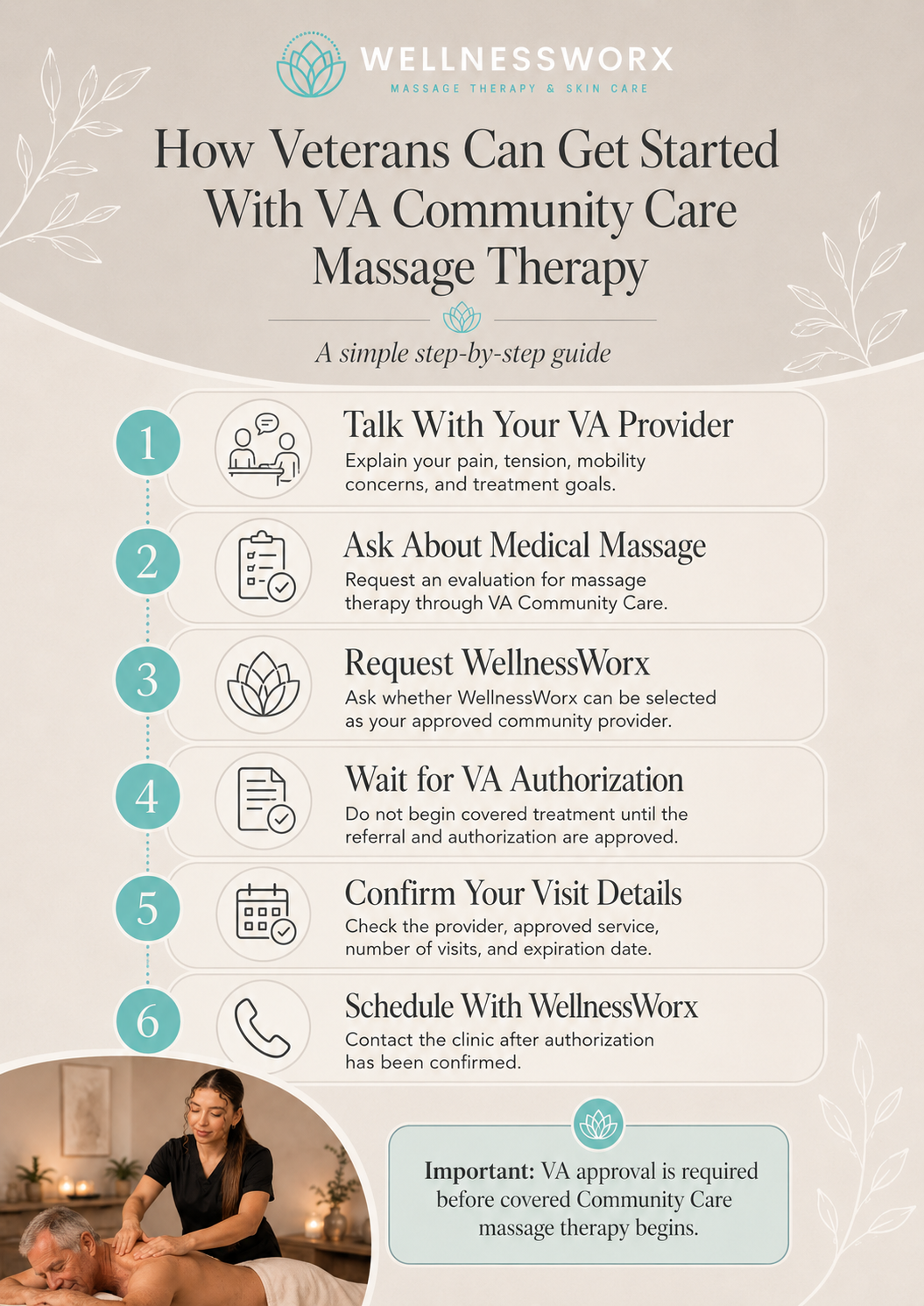
1. Talk with your VA healthcare provider
Start by discussing your symptoms with your VA primary care provider, specialist, pain management provider, or Whole Health team.
Describe how the problem affects your daily life. Helpful details may include:
Where you experience pain or muscle tension
How long the symptoms have been present
Whether your movement or flexibility is limited
Activities that make the problem better or worse
Previous injuries, surgeries, or treatment
How the condition affects sleep, work, exercise, or daily activities
Treatments you have already tried
You can directly ask whether medical massage therapy may be appropriate as part of your care plan. The VA also advises veterans interested in massage therapy to speak with their healthcare provider or contact their local Whole Health point of contact.
A simple way to begin the conversation is:
“I have ongoing pain and muscle tension that are affecting my movement and daily activities. Could medical massage therapy be appropriate for my condition, and could I be evaluated for a VA Community Care referral?”
2. Ask about receiving care from WellnessWorx
Veterans may ask their VA care team about a particular in-network community provider.
WellnessWorx serves eligible veterans through VA Community Care and TriWest at its Glendora location. California is part of VA Community Care Network Region 4, for which TriWest Healthcare Alliance serves as the third-party administrator.
You may give your VA care team the following information:
WellnessWorx Massage Therapy & Skin Care
1200 E Route 66, Suite 115
Glendora, CA 91741
Phone: (909) 631-6012
Requesting a particular provider does not guarantee that the referral will be issued to that provider. The VA must verify eligibility, network participation, availability, and the requirements of the treatment plan.
3. Wait for the VA to review the request
The VA reviews the request to determine whether the veteran is eligible for community care and whether the requested treatment is appropriate.
According to the VA, preparing a Community Care referral can take up to 14 days in some cases. The VA may contact the veteran to confirm the requested service, preferred provider, or appointment needs.
Do not assume that a referral request has been approved merely because it was discussed with a provider. Wait until the referral and authorization have been completed.
4. Confirm the referral and authorization
A referral begins the process of sending a veteran to a community provider. The authorization confirms the specific care the VA has approved.
The VA authorization letter may include:
The authorization number
The approved community provider
A description of the authorized service
The approved number or frequency of appointments
The period during which care may be provided
Instructions related to the authorized treatment
The authorization letter is the veteran’s confirmation that the community care has been approved. The VA will generally not cover treatment that falls outside the services, visits, provider, or timeframe listed in the authorization.
5. Contact WellnessWorx to schedule
Once the referral has been assigned and authorization has been confirmed, contact WellnessWorx to schedule your first appointment.
The WellnessWorx team can help verify that the referral information has been received and explain what information is needed before treatment begins. However, WellnessWorx cannot independently approve VA benefits or change the number of visits authorized by the VA.
If you choose to schedule the community appointment yourself, the VA recommends notifying your VA healthcare team within 14 days so the appointment can be documented and coordinated with the community provider.
What Should You Bring to Your First Appointment?
Before your first veteran massage therapy appointment, gather any available information related to your authorized care.
You may be asked to provide:
A government-issued photo ID
Your VA referral or authorization information
The authorization number
A list of current medications
Relevant health and surgical history
Information about previous injuries
Details about where you experience pain or restriction
Relevant imaging or records when specifically requested
The VA may share applicable medical records with the community provider. Veterans should still bring copies of imaging, such as an MRI or CT scan, when the provider asks for them.
Tell your massage therapist about any blood-thinning medication, recent surgery, fractures, implanted medical devices, circulation concerns, skin conditions, or other issues that could affect treatment.
What Happens During a Veteran Massage Therapy Appointment?
Your first appointment will usually begin with a discussion about your symptoms, approved treatment plan, comfort level, and goals.
The therapist may ask:
Which areas feel painful, tight, or restricted
Which movements are difficult
Whether pressure aggravates your symptoms
How the condition affects daily activities
What treatments have helped in the past
What you hope to improve during the authorized care period
Massage therapy through VA Community Care is not necessarily a standard full-body spa massage. Treatment is typically tailored to the clinical concern and authorization.
Depending on the area being treated, the veteran may lie face down, face up, or on their side. Treatment can also be performed while seated when lying on a table is uncomfortable. Appropriate draping and communication should be used to protect the veteran’s comfort and privacy.
At WellnessWorx, sessions may incorporate medical massage, focused therapeutic techniques, deep-tissue work, mobility-focused bodywork, or relaxation-based massage according to the veteran’s approved care plan and individual needs.
Does Medical Massage Have to Be Painful?
No. Medical massage does not need to be extremely painful to be effective.
Veterans experiencing chronic pain, nerve sensitivity, previous injuries, or heightened sensitivity may respond poorly to overly aggressive pressure. Pressure and techniques should be adjusted according to:
The condition being addressed
The veteran’s comfort and sensitivity
The authorized treatment goals
The body’s response during the session
Any relevant medical precautions
Some focused work may feel tender, but sharp pain, worsening numbness, tingling, dizziness, or other concerning symptoms should be reported immediately.
Medical massage describes the treatment’s purpose—not a requirement that the therapist always use deep pressure.
How Many Massage Therapy Visits Will the VA Authorize?
The number of covered appointments is determined by the VA and will be listed in the authorization.
VA clinical information notes that medical massage treatment can often be accomplished in approximately eight to ten visits over 12 weeks. That is general guidance, however, and it does not mean every veteran will receive that exact number of sessions. Individual authorizations may differ based on the condition, care plan, clinical judgment, and local VA procedures.
Veterans should track:
How many approved visits they have used
How many visits remain
The authorization’s expiration date
Whether the VA requires additional documentation
Whether continued treatment will require a new referral
Do not assume that unused visits remain available after the authorization expires.
What If You Need Additional Appointments?
If you are approaching the end of your authorized visits but believe continued treatment may be helpful, discuss it with your therapist and VA healthcare team before the authorization expires.
The community provider may be able to submit documentation or request additional services, but the VA must review and approve continued care. A recommendation from the massage therapist does not automatically extend the authorization.
The VA advises veterans to keep track of their approved visits and authorization period. If additional treatment is needed, either the veteran or community provider may request a new referral.
Will the VA Pay for an Appointment Scheduled Before Authorization?
Routine non-emergency community care generally requires prior VA approval.
Scheduling or receiving massage therapy before authorization has been confirmed could leave the veteran responsible for the cost. The safest approach is to verify all of the following before the first covered appointment:
The referral has been approved
WellnessWorx is listed as the authorized provider
Massage therapy is the authorized service
The authorization is currently active
The appointment falls within the approved date range
Visits remain available
If you receive a bill for properly authorized in-network community care, contact the VA Community Care team listed on your authorization paperwork rather than ignoring the bill. The VA confirms that care outside the authorization may not be covered.
VA Community Care Massage Therapy in Glendora, CA
WellnessWorx Massage Therapy & Skin Care is honored to provide personalized massage therapy for eligible veterans through VA Community Care and TriWest.
Our team focuses on compassionate, individualized care for veterans experiencing concerns such as:
Chronic pain and muscle tension
Neck, shoulder, and back discomfort
Limited mobility and stiffness
Injury-related soreness
Headaches associated with muscle tightness
Stress and nervous-system tension
Difficulty remaining active and comfortable
Every appointment is adapted to the veteran’s approved treatment plan, symptoms, comfort level, and goals.
Veterans who already have an authorization—or who need help understanding what information to request—can contact WellnessWorx at (909) 631-6012.
This article is provided for general educational purposes. VA Community Care eligibility, referrals, authorizations, coverage, and approved visits are determined by the Department of Veterans Affairs. Veterans should confirm their individual benefits and authorization details with their VA healthcare team before receiving community care.
Frequently Asked Questions
-
Yes. Veterans generally need approval and a referral from their VA healthcare team before scheduling covered massage therapy with a community provider. You should also confirm that the authorization lists the correct provider, service, number of visits, and treatment period.
-
Yes. You may contact WellnessWorx to ask about the process and what information will be needed. However, covered appointments should not begin until the VA referral and authorization have been confirmed. Calling WellnessWorx does not create or approve a VA authorization.
-
No. The VA may cover clinically appropriate massage therapy when it is approved as part of the veteran’s care and provided by an authorized in-network provider. The authorization determines the approved service. Unapproved spa services, upgrades, or treatments outside the authorization may not be covered.
-
The number of appointments varies. Your authorization letter should state how many visits are approved and how long the authorization remains active. General VA clinical guidance may differ from your individual authorization, so always follow the limits listed in your paperwork.
-
Bring a photo ID, your referral or authorization information, a current medication list, and relevant health history. You should also bring imaging or medical records if requested and be prepared to explain your symptoms, previous injuries, treatment goals, and any areas that require special care.
