
Massage vs. Acupuncture: Which Is Right for Your Goals?
Massage therapy and acupuncture are both commonly used to support pain management, mobility, relaxation, and overall wellness—but they work in very different ways.
Massage uses hands-on pressure, movement, stretching, and soft-tissue techniques. Acupuncture involves the insertion of very thin needles at specific points on the body by a qualified practitioner.
So which one should you choose?
The answer depends on what you are trying to improve, what is contributing to your symptoms, your health history, and which type of treatment feels most comfortable to you.
For someone whose primary concern is tight, overworked muscles, massage may be a natural place to start. Someone managing certain chronic pain conditions or wanting a treatment that does not rely on manual pressure may be interested in acupuncture. And for some people, the two approaches may complement one another as part of a broader care plan.
Research suggests that both massage and acupuncture may be useful for some pain conditions, although neither treatment works for everyone and the quality of evidence varies depending on the condition.
What Is Massage Therapy?
Massage therapy uses manual techniques to work with muscles and other soft tissues.
Depending on your goals, a session may include:
Light or moderate therapeutic massage
Deep-tissue techniques
Trigger-point work
Myofascial techniques
Mobility-focused bodywork
Relaxation techniques
The therapist may focus on one specific problem area or provide a more general treatment.
Massage is often chosen for concerns involving:
Muscle tightness
Neck and shoulder tension
Lower-back discomfort
Postural strain
Exercise-related soreness
Limited mobility
Muscle guarding
Stress and relaxation
Chronic muscular discomfort
Massage may provide short-term improvements for some types of musculoskeletal pain, although the strength of the evidence varies. For example, research on lower-back pain suggests possible short-term benefits, while longer-term effects are less certain.
What Is Acupuncture?
Acupuncture is a practice in which a trained practitioner inserts very thin needles through the skin at selected points on the body.
Modern acupuncture may be used as a complementary approach for concerns such as:
Lower-back pain
Certain headache conditions
Osteoarthritis-related pain
Fibromyalgia-related pain
Other symptoms depending on the individual's care plan
Research reviewed by the National Center for Complementary and Integrative Health suggests acupuncture may be helpful for several chronic pain conditions, including back and neck pain, knee osteoarthritis, and some headache disorders.
Acupuncture should be performed by an appropriately trained practitioner using sterile, single-use needles. The FDA regulates acupuncture needles as medical devices and requires that they be sterile and labeled for single use.
Massage vs. Acupuncture: What's the Main Difference?
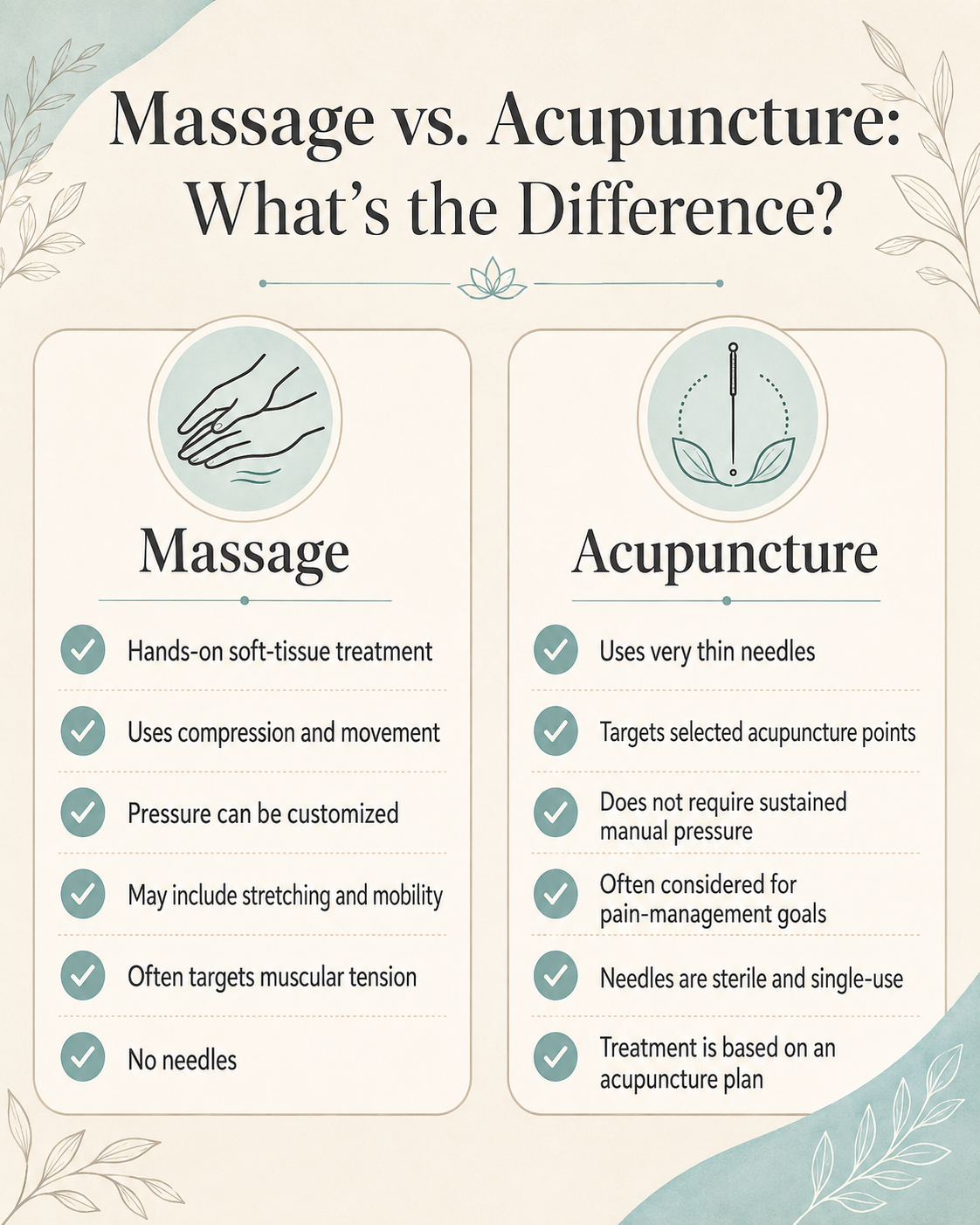
Neither approach is automatically “better.”
The better question is:
Which approach fits the problem you are trying to address?
When Might Massage Be the Better Fit?
Massage may be particularly appealing when your main complaint feels muscular.
Tight or Overworked Muscles
If your shoulders feel knotted, your hips feel tight, or your back muscles feel fatigued after work or exercise, massage allows the therapist to work directly with those areas.
The session may focus on:
Tight tissue
Muscle guarding
Trigger points
Surrounding compensating muscles
Areas restricted by soft-tissue tension
Limited Movement Related to Muscle Tightness
When muscle tension contributes to difficulty turning your neck, reaching overhead, bending, or moving comfortably, massage may be combined with gentle stretching or mobility-focused techniques.
Massage cannot correct every structural reason for limited mobility, but it may help when soft-tissue restriction is part of the problem.
Post-Workout Soreness and Recovery
Active clients may choose sports massage, targeted therapeutic massage, stretching, or cupping to address muscle fatigue and post-exercise tightness.
Massage does not repair a torn muscle or allow someone to safely train through an injury. New or significant sports injuries should be appropriately evaluated.
Stress and Relaxation
Massage may be especially appealing when your goals include both physical comfort and relaxation.
The predictable rhythm and touch of massage may help reduce generalized tension and create a calming experience.
When Might Acupuncture Be the Better Fit?
Acupuncture may be worth considering when your goals involve certain chronic pain conditions or when manual pressure is not the treatment experience you prefer.
Chronic Lower-Back Pain
Acupuncture is one of the complementary approaches that has been studied extensively for chronic lower-back pain.
NCCIH reports that research has found acupuncture associated with improvements in pain and function compared with no acupuncture treatment, and clinical guidelines have included acupuncture among non-drug options for chronic lower-back pain.
Massage may also provide short-term relief for some lower-back pain, but the evidence supporting massage for chronic lower-back pain is weaker.
Certain Headache Conditions
Acupuncture has been studied for headache prevention and chronic headache conditions.
Research reviewed by NCCIH suggests acupuncture can be a reasonable option for some chronic pain conditions that include headache.
Massage may still help when headaches are accompanied by neck, shoulder, scalp, or jaw muscle tension, but it should not be assumed that every headache is muscular.
Osteoarthritis-Related Pain
Acupuncture has shown potential benefit for some people with knee osteoarthritis.
NCCIH notes that evidence is strongest for knee osteoarthritis, although recommendations remain conditional and research results are not completely consistent.
Massage may help surrounding muscle tension and comfort but cannot reverse joint degeneration.
When You Don't Want Deep Manual Pressure
Some clients simply do not enjoy massage pressure.
Acupuncture provides a very different treatment experience and may appeal to people who want a complementary pain-management approach without prolonged pressing or kneading of sensitive muscles.
Which Is Better for Muscle Tension?
For straightforward muscular tension, massage is often the more direct option.
A massage therapist can:
Palpate tight tissues
Adjust pressure immediately
Spend more time on a particular muscle group
Work with surrounding compensating muscles
Incorporate stretching
Modify positioning
Address several related areas during the same appointment
Acupuncture may also be incorporated into care for pain and muscular complaints, but massage provides direct hands-on treatment of the soft tissues.
If your primary complaint is:
“My shoulders are constantly tight.”
or:
“My glutes and hips feel locked up after sitting all day.”
massage may be a logical starting point.
Which Is Better for Chronic Pain?
This depends heavily on the cause of the pain.
Chronic pain is complex and may involve muscles, joints, nerves, previous injuries, medical conditions, nervous-system sensitivity, sleep, stress, and other factors.
Research suggests both acupuncture and massage may have a role in managing certain chronic pain conditions. NCCIH notes a growing body of evidence supporting several complementary approaches—including acupuncture and massage—for some types of chronic pain.
However, the research is condition-specific.
For example:
Chronic lower-back pain: Evidence is stronger for acupuncture than massage.
Neck pain: Both approaches may provide benefit for some people, although massage benefits may be short-term.
Fibromyalgia: Research suggests possible benefits from both acupuncture and massage.
Knee osteoarthritis: Acupuncture has stronger supporting research than massage.
That does not mean the treatment with “better evidence” will necessarily feel better for every individual.
Your diagnosis, symptoms, preferences, and other care matter.
Which Is Better for Headaches?
It depends on the type of headache.
Massage may be useful when:
Neck muscles feel tight
Shoulders are chronically tense
The base of the skull feels tender
Jaw clenching contributes to muscle tension
Posture appears to aggravate the surrounding muscles
Relaxation is one of your primary goals
Acupuncture may be considered when:
Headaches are recurring
You have a diagnosed headache disorder
You are looking for another non-drug management strategy
Your healthcare provider has recommended acupuncture
Neither massage nor acupuncture should be used to delay evaluation of new, severe, unusual, or rapidly changing headaches.
Which Is Better for Lower-Back Pain?
Again, it depends on what is causing the pain.
Massage may be particularly useful for:
Lower-back muscle tension
Tight glutes and hips
Protective guarding
Soft-tissue stiffness
Postural strain
Compensating muscles
Acupuncture may be considered for:
Chronic lower-back pain
Certain recurring pain patterns
A broader non-drug pain-management strategy
Acupuncture has stronger research support for chronic lower-back pain, while massage may provide short-term relief for some people.
Neither can repair a herniated disc, reverse significant spinal stenosis, or replace medical evaluation when neurological symptoms are present.
Which Is Better for Stress?
Massage often has an advantage when the main goal is simply to unwind.
A relaxation-focused massage can provide sustained hands-on treatment in a comfortable environment while addressing generalized muscle tension.
Acupuncture sessions may also feel very relaxing to some clients, and people sometimes rest quietly while the needles remain in place.
Personal preference plays a large role here.
Someone who loves therapeutic touch may prefer massage.
Someone who wants quiet treatment with minimal physical manipulation may prefer acupuncture.
Do Acupuncture Needles Hurt?
Many people are surprised by how thin acupuncture needles are.
The sensation can vary. Some people notice:
A small pinch during insertion
Pressure
Tingling
Heaviness
Warmth
A dull ache
Little or no sensation
Acupuncture should be performed by a qualified practitioner using sterile, single-use needles. When performed appropriately, acupuncture is generally considered safe. Serious adverse events are uncommon but can include infection or injury if treatment is performed improperly.
Tell your practitioner immediately if something feels sharply painful or unusual.
Does Massage Hurt?
Massage does not have to hurt either.
Pressure can range from very light to firm depending on:
The treatment goal
Your sensitivity
The area being treated
Your health history
Your preferences
Deep pressure should not be treated as proof that the massage is more effective.
Rare serious complications from massage have been reported, particularly with vigorous massage or people who have increased risk of injury.
Communication should remain open throughout the session.
Can You Combine Massage and Acupuncture?
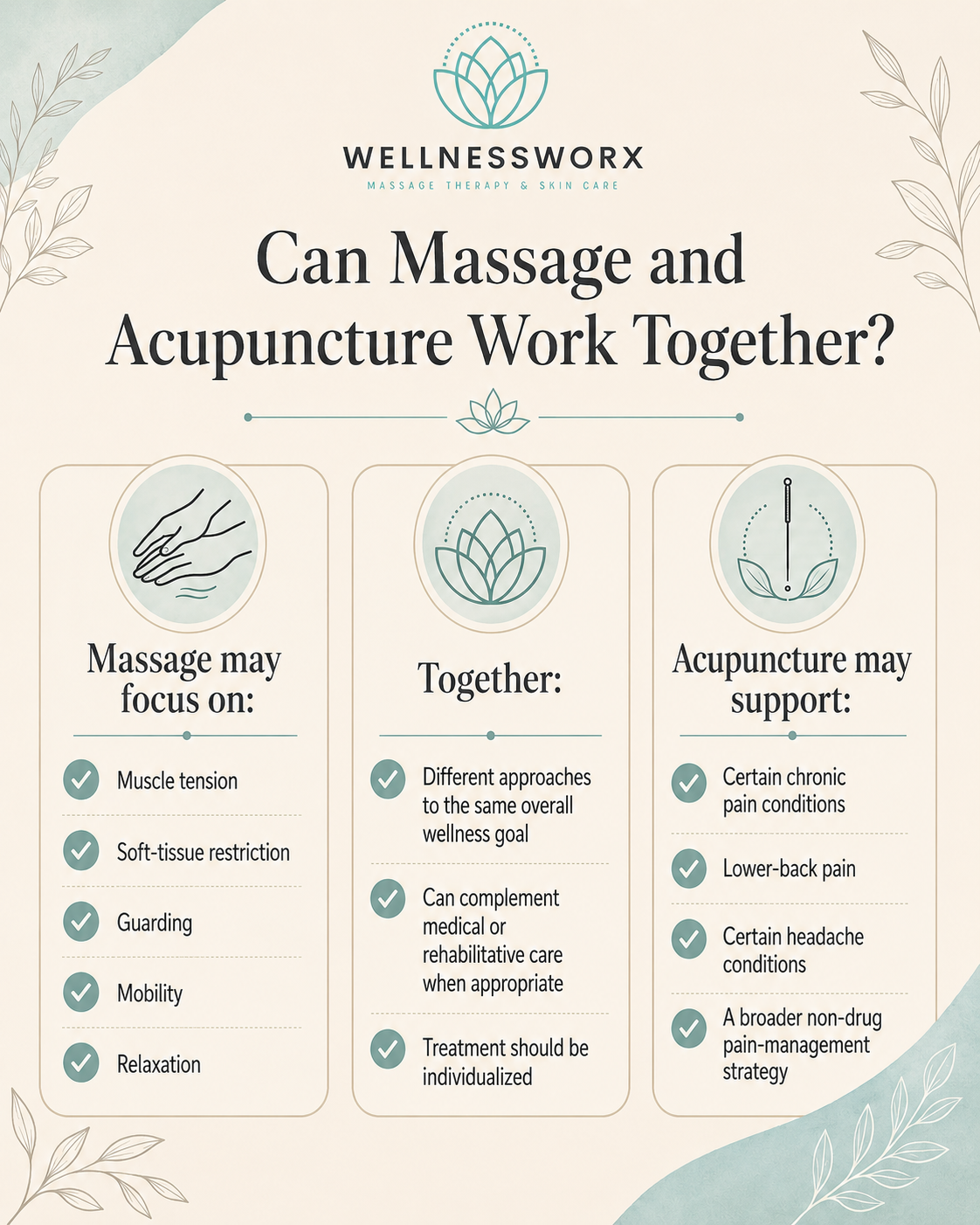
Yes, in some circumstances.
Massage and acupuncture use different treatment approaches, so they may complement each other rather than compete.
For example, someone managing chronic neck and shoulder discomfort might use:
Acupuncture
to support a broader pain-management strategy
and
Massage
to address the muscular tension and guarding around the neck, shoulders, and upper back.
Another client may use acupuncture for chronic lower-back pain while receiving massage periodically for hip and glute tension.
There is no evidence that everyone needs both treatments, and combining therapies does not automatically make treatment more effective.
The decision should be based on your symptoms, goals, medical history, and response.
Can You Receive Massage and Acupuncture on the Same Day?
Sometimes, but it should be individualized.
Whether receiving both treatments on the same day makes sense may depend on:
Your health
The intensity of the massage
The acupuncture treatment
Your sensitivity
Previous experience
Your practitioner's recommendations
Some people prefer to separate appointments so they can determine how they respond to each treatment individually.
If you are new to both therapies, starting with one treatment at a time may make it easier to understand what feels helpful.
What Happens During a Massage Appointment?
A therapeutic massage appointment may begin with a discussion about:
Where you feel discomfort
How long symptoms have been present
Previous injuries
Medical conditions
Medications
Activity limitations
Your pressure preferences
Your treatment goals
Your therapist then develops a treatment approach based on your needs.
Depending on your session, you may receive:
Deep-tissue techniques
Trigger-point work
Myofascial techniques
Mobility work
Relaxation-focused massage
Your therapist should check your comfort and adjust pressure and positioning when needed.
What Happens During an Acupuncture Appointment?
An acupuncture appointment also begins with an intake and discussion.
The practitioner may ask about:
Your primary concern
How long symptoms have been present
Pain patterns
Sleep
Stress
Medications
Medical conditions
Previous treatment
Overall health
You will then be positioned comfortably while very thin needles are placed at selected acupuncture points.
The needles may remain in place for part of the session while you rest.
Your practitioner should explain what to expect and answer questions before beginning treatment.
Massage vs. Acupuncture at a Glance
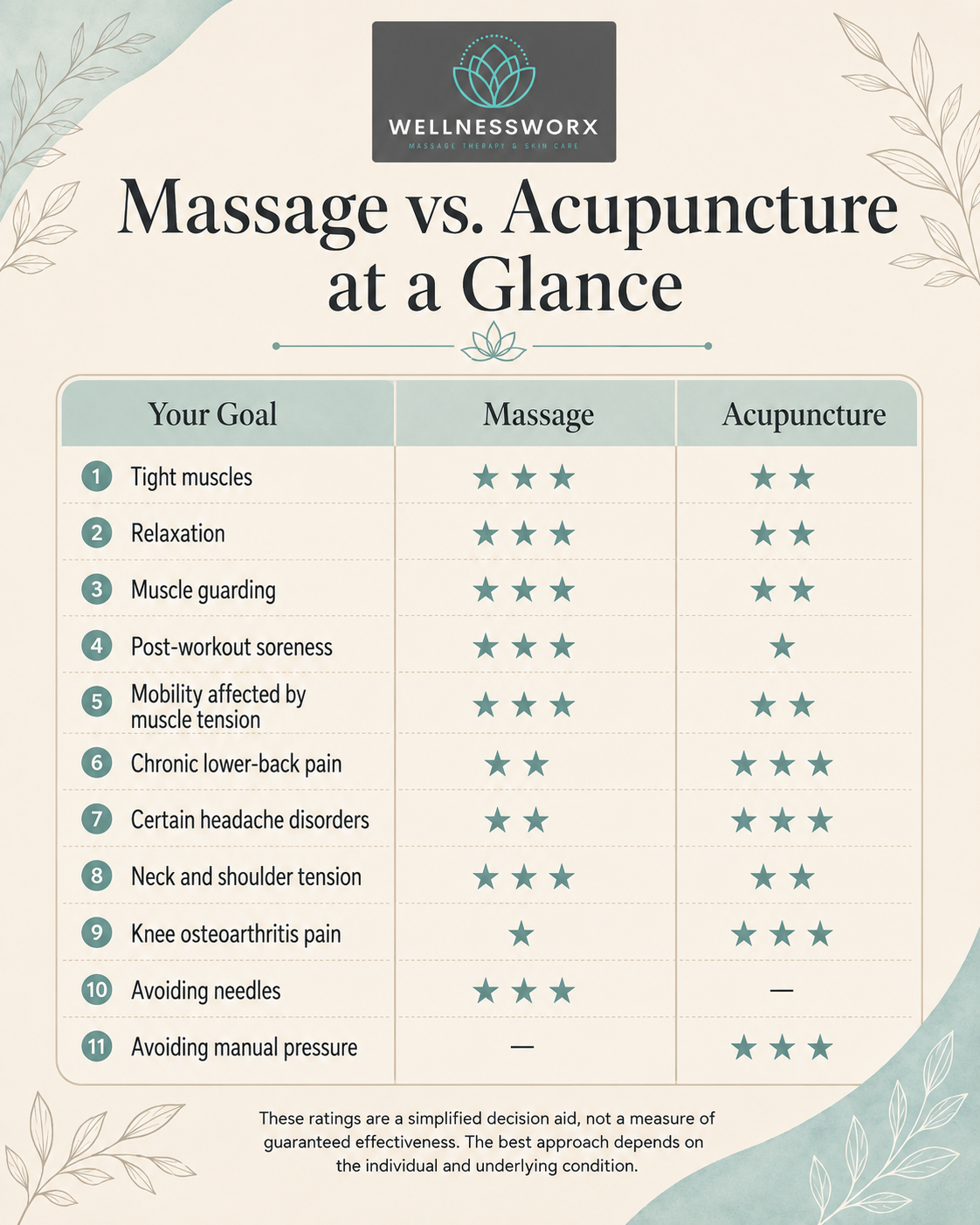
These ratings are a simplified decision aid, not a measure of guaranteed effectiveness. The best approach depends on the individual and underlying condition.
How Do You Decide Which One to Try First?
Ask yourself what your primary goal is.
Start with massage when:
Your muscles feel tight or overworked
You want hands-on treatment
You have specific muscle knots
You want stretching or mobility work
You want relaxation along with therapeutic treatment
You want targeted treatment of compensating muscles
You do not want needles
Consider acupuncture when:
You have a chronic pain condition for which acupuncture has research support
You have chronic lower-back pain
You have a diagnosed headache condition
You are interested in a complementary treatment that does not rely on manual pressure
Your healthcare provider has suggested acupuncture
Massage alone has not addressed your goals
Consider both when:
Your condition involves both chronic pain and substantial muscular tension
You respond positively to each treatment
Both practitioners believe the combination is appropriate
The treatments complement a broader medical or rehabilitation plan
When Should You Seek Medical Care Instead?
Neither massage nor acupuncture should be the first response to every symptom.
Medical evaluation is important for:
New or unexplained severe pain
Rapidly worsening symptoms
Significant trauma
New muscle weakness
Increasing numbness
Loss of coordination
New bowel or bladder problems
Fever with significant pain
Chest pain
Shortness of breath
Unexplained swelling
Sudden severe headaches
Neurological changes
Complementary therapies should support appropriate medical care rather than delay it. NCCIH specifically advises discussing complementary approaches with healthcare providers and not using them to postpone evaluation of a health problem.
Are Massage and Acupuncture Safe?
Both generally have favorable safety records when provided appropriately by trained professionals.
Massage may need to be modified or avoided with:
Known or suspected blood clots
Certain bleeding disorders
Anticoagulant medication
Fragile bones
Open wounds
Active skin infections
Recent surgery
Certain pregnancy-related concerns
Other medical restrictions
Forceful massage should be avoided in people with certain bleeding conditions or those taking anticoagulant medication.
Acupuncture requires additional consideration with:
Bleeding concerns
Certain medications
Pregnancy
Skin infection near needle sites
Some implanted medical devices if electrical stimulation is being considered
Other conditions identified during intake
Acupuncture needles should always be sterile and single use. Improper technique can cause infection and other serious complications, although these events are uncommon with qualified practitioners.
Always share your complete health history with your practitioner before treatment.
Massage and Acupuncture in Glendora, CA
WellnessWorx Massage Therapy & Skin Care gives clients in Glendora access to complementary wellness services that can be selected according to their individual goals.
Massage may be appropriate when your concerns involve muscle tension, stiffness, limited movement, stress, recovery, or muscular discomfort.
Acupuncture may be considered for clients exploring another complementary approach for pain management or other treatment goals.
For some people, the best plan may involve one approach. For others, massage and acupuncture may complement one another alongside care from physicians, physical therapists, and other healthcare professionals.
Rather than asking:
“Which treatment is better?”
a more useful question may be:
“Which treatment best matches what I am trying to improve?”
If you are unsure where to start, contact WellnessWorx to discuss your goals and determine which service may be appropriate.
This article is provided for general educational purposes and is not intended to diagnose a condition, recommend a specific medical treatment, or replace care from an appropriate healthcare professional.
Frequently Asked Questions
-
It depends on the type and cause of the pain. Massage may be especially useful when muscle tension, guarding, or soft-tissue stiffness contributes to discomfort. Acupuncture has stronger research support for certain conditions, including chronic lower-back pain. Neither treatment works for everyone.
-
Acupuncture has stronger research support for chronic lower-back pain, while massage may provide short-term relief for some people and may be particularly useful when muscular tension is involved. The most appropriate treatment depends on the underlying cause and individual response.
-
Yes. Some people incorporate both treatments into a broader wellness or pain-management plan. Massage may address surrounding muscular tension while acupuncture provides a different type of complementary treatment. Using both is not automatically better, and treatment should be individualized.
-
Acupuncture may be an option for someone who does not enjoy manual pressure. However, massage does not have to be deep. A massage therapist can use light or moderate pressure and customize treatment according to your sensitivity.
-
Consider your main goal. Massage may be a natural first choice for muscle tightness, knots, postural strain, recovery, mobility, or relaxation. Acupuncture may be worth considering for certain chronic pain conditions, recurring headaches, or when you want a complementary treatment without sustained manual pressure.
